>
Clupeiformes (Herrings) >
Dorosomatidae (Gizzard shads and sardinellas)
Etymology: Rhinosardinia: Greek, rhinos = nose + Latin, sardina, derived from Greek, sarda = sardine and also connected with the island of Sardinia (Ref. 45335).
More on author: Steindachner.
Entorno: milieu / zona climática / rango de profundidad / gama de distribución
Ecología
; agua dulce; salobre pelágico. Tropical; 10°N - 8°S, 69°W - 47°W (Ref. 188)
South America: lower reaches of the Orinoco, rivers of the Guianas, Amazon at Pará, but undoubtedly elsewhere in its lower part.
Tamaño / Peso / Edad
Madurez: Lm ? range ? - ? cm
Max length : 11.0 cm TL macho / no sexado; (Ref. 105080); common length : 5.0 cm SL macho / no sexado; (Ref. 188)
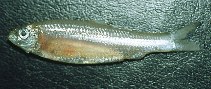
Espinas dorsales (total) : 0; Radios blandos dorsales (total) : 13 - 21; Espinas anales: 0; Radios blandos anales: 15 - 18. Belly strongly keeled; two distinct parallel striae on scales; a silver stripe along flank in some specimens. Easily separated from all other clupeids in the area by the sharp retrorse spine on the upper part of the maxilla at about the level of the eye center. Distinguished from the very similar R. bahiensis mainly by having fewer vertebrae (38 or 39) and fewer scales in lateral series (Ref. 188). Body silvery, head yellowish white (Ref. 37032).
Body shape (shape guide): fusiform / normal; Cross section: compressed.
A riverine freshwater species, but also tolerates brackish water. Presumably schooling. Feeds on zooplankton.
Ciclo vital y comportamiento de apareamiento
Madurez | Reproducción | Puesta | Huevos | Fecundidad | Larva
Whitehead, P.J.P., 1985. FAO Species Catalogue. Vol. 7. Clupeoid fishes of the world (suborder Clupeoidei). An annotated and illustrated catalogue of the herrings, sardines, pilchards, sprats, shads, anchovies and wolf-herrings. FAO Fish. Synop. 125(7/1):1-303. Rome: FAO. (Ref. 188)
Situación en la Lista Roja de la UICN (Ref. 130435: Version 2025-2 (Global))
Amenaza para el ser humano
Harmless
Usos humanos
Pesquerías: pesquerías de subsistencia
Herramientas
Informes especiales
Descargar XML
Fuentes de Internet
Estimaciones basadas en modelos
Índice de diversidad filogenética (Referencia
82804): PD
50 = 0.7500 [Uniqueness, from 0.5 = low to 2.0 = high].
Bayesian length-weight: a=0.00646 (0.00412 - 0.01012), b=3.12 (2.99 - 3.25), in cm total length, based on LWR estimates for this species & (Sub)family-body (Ref.
93245).
Nivel trófico (Referencia
69278): 3.4 ±0.45 se; based on food items.
Resiliencia (Referencia
120179): Alto, población duplicada en un tiempo mínimo inferior a 15 meses (Preliminary K or Fecundity.).
Vulnerabilidad pesquera (Ref.
59153): Low vulnerability (10 of 100).
🛈