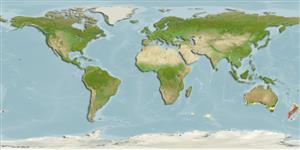
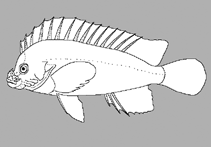
Meio ambiente: milieu / Zona climática / intervalo de profundidade / faixa de distribuição
Ecologia
marinhas demersal; intervalo de profundidade 22 - 222 m (Ref. 58489), usually ? - 100 m (Ref. 30464). Temperate
Southwest Pacific: in temperate waters.
Tamanho / Peso / Idade
Maturidade: Lm ? range ? - ? cm
Max length : 35.0 cm TL macho/indeterminado; (Ref. 30464); common length : 20.0 cm TL macho/indeterminado; (Ref. 30464)
Occur in the continental shelf (Ref. 7300, 75154). Benthic (Ref. 75154). Sedentary fishes that swim slowly and spend much of their time resting on the bottom. They use the long snout for probing in crevices, seaweed and sand for crabs, worms, and other benthic invertebrates (Ref. 30464). Neither anterolateral glandural groove nor venom gland is present (Ref. 57406).
Ciclo de vida ou comportamento de acasalamento
Maturidade | Reprodução | Desova | Ovos | Fecundidade | Larvas
Paxton, J.R., D.F. Hoese, G.R. Allen and J.E. Hanley, 1989. Pisces. Petromyzontidae to Carangidae. Zoological Catalogue of Australia, Vol. 7. Australian Government Publishing Service, Canberra, 665 p. (Ref. 7300)
Status na Lista Vermelha da UICN (Ref. 130435: Version 2025-2 (Global))
Ameaça para os humanos
Harmless
Uso pelos humanos
Pescarias: sem interesse
Ferramentas
Relatórios especiais
Baixar XML
Fontes da internet
Estimativas baseadas em modelos
Temperatura preferida (Ref.
123201): 10 - 18.1, mean 15.1 °C (based on 157 cells).
Índice de diversidade filogenética (Ref.
82804): PD
50 = 0.5312 [Uniqueness, from 0.5 = low to 2.0 = high].
Bayesian length-weight: a=0.01995 (0.00906 - 0.04395), b=3.01 (2.83 - 3.19), in cm total length, based on all LWR estimates for this body shape (Ref.
93245).
Nível Trófico (Ref.
69278): 3.8 ±0.4 se; based on size and trophs of closest relatives
Vulnerabilidade da pesca (Ref.
59153): Low vulnerability (25 of 100).
🛈