>
Clupeiformes (Herrings) >
Dorosomatidae (Gizzard shads and sardinellas)
Etymology: Sardinella: Latin and Greek, sarda = sardine; name related to the island of Sardinia; diminutive (Ref. 45335).
More on author: Bleeker.
Περιβάλλον: περιβάλλον / κλιματική ζώνη / εύρος βάθους / εύρος διανομής
Οικολογία
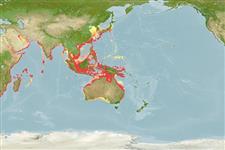
Θαλασσινό(ά) pelagic-neritic; εύρος βάθους 10 - 70 m (Ref. 12260). Tropical; 41°N - 37°S, 19°E - 155°E
Indo-West Pacific: widespread including the Red Sea, and reported as an invasive species in the eastern Mediterranean basin.
Μήκος κατά την πρώτη ωρίμανση / Μέγεθος / Βάρος / Ηλικία
Γεννητική Ωρίμανση: Lm 13.3, range 10 - ? cm
Max length : 29.6 cm TL αρσενικό/απροσδιόριστο; (Ref. 116943); common length : 15.0 cm SL αρσενικό/απροσδιόριστο; (Ref. 188); μεγ. αναφερόμενη ηλικία: 7 έτη (Ref. 1488)
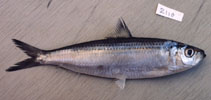
Ραχιαίες άκανθες (συνολικά) : 0; Μαλακές ραχιαίες ακτίνες (συνολικά) : 13 - 21; Εδρικές άκανθες: 0; Μαλακές εδρικές ακτίνες: 12 - 23. Total number scutes 32 to 34. Vertical striae on scales not meeting at center, numerous small perforations on hind part of scale. A golden mid-lateral line down flank; dorsal and caudal fin margins dusky; a dark spot at dorsal fin origin. Lower gill rakers 45 to 59 (at 6 to 17 cm standard length, not increasing with size of fish after 6 cm standard length).
Body shape (shape guide): fusiform / normal; Cross section: compressed.
Forms schools in coastal waters. Adults feed on phytoplankton and zooplankton (crustacean and molluscan larvae) (Ref. 5213, 5284). Juveniles predominantly prefer crustaceans expanding to include phytoplankton in the diet as their length increases (Ref. 34224). Marketed fresh, dried-salted, boiled or made into fish balls. Possible or even probable confusion with other species (especially S. fimbriata in Indian waters) makes published biological data potentially unreliable.
Stern, N., B. Rinkevich and M. Goren, 2016. Integrative approach revises the frequently misidentified species of Sardinella (Clupeidae) of the Indo-West Pacific Ocean. J. Fish Biol. 89(5):2282-2305. (Ref. 114969)
Κατάσταση Κόκκινου Καταλόγου IUCN (Ref. 130435: Version 2025-2 (Global))
Απειλή για τον άνθρωπο
Harmless
Ανθρώπινες χρήσεις
αλιεία: πολύ εμπορικό
Εργαλεία
Ειδικές εκθέσεις
Λήψη XML
Διαδικτυακές πηγές
Εκτιμήσεις βάσει μοντέλων
Προτιμώμενη θερμοκρασία (Αναφ.
123201): 23.6 - 29.1, mean 28.1 °C (based on 1384 cells).
Δείκτης φυλογενετικής ποικιλότητας (Αναφ.
82804): PD
50 = 0.5000 [Uniqueness, from 0.5 = low to 2.0 = high].
Bayesian length-weight: a=0.00813 (0.00670 - 0.00986), b=3.04 (3.01 - 3.07), in cm total length, based on LWR estimates for this species (Ref.
93245).
Τροφικό Επίπεδο (Αναφ.
69278): 2.9 ±0.30 se; based on food items.
Generation time: 1.1 (0.8 - 2.6) years. Estimated as median ln(3)/K based on 13
growth studies.
Ελαστικότητα (Αναφ.
120179): Υψηλό, ελάχιστος χρόνος για διπλασιασμό πληθυσμού < 15 μήνες (K=0.32-1.8; tmax=7).
Prior r = 1.07, 95% CL = 0.71 - 1.60, Based on 4 data-limited stock assessments.
Ευπάθεια στην αλιεία (Ref.
59153): Low vulnerability (19 of 100).
🛈
Ευπάθεια στο κλίμα (Ref.
125649): Moderate to high vulnerability (47 of 100).
🛈
Θρεπτικά συστατικά (Ref.
124155): Calcium = 252 [134, 390] mg/100g; Iron = 2.14 [1.25, 3.86] mg/100g; Protein = 20.6 [19.6, 21.6] %; Omega3 = 0.281 [0.140, 0.540] g/100g; Selenium = 127 [68, 257] μg/100g; VitaminA = 15.3 [5.1, 45.0] μg/100g; Zinc = 1.16 [0.84, 1.63] mg/100g (wet weight); based on
nutrient studies.