>
Kurtiformes (Nurseryfishes, cardinalfishes.) >
Apogonidae (Cardinalfishes) > Apogoninae
Etymology: Siphamia: A Swazi word, siphama, for a fish.
More on author: Castelnau.
Umwelt: Milieu / Klimazone / Tiefenbereich / Verbreitungsgebiet
Ökologie
seewasser; brackwasser benthopelagisch; tiefenbereich 0 - 7 m (Ref. 57178). Temperate; 25°S - 45°S
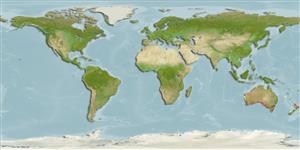
Eastern Indian Ocean: endemic to southern Australia, from Shark Bay, Western Australia to Byron Bay, New South Wales.
Größe / Gewicht / Alter
Geschlechtsreife: Lm ? range ? - ? cm
Max length : 5.0 cm SL Männchen/unbestimmt; (Ref. 26498)
Kurzbeschreibung
Bestimmungsschlüssel | Morphologie | Morphometrie
Rückenflossenstacheln (insgesamt) : 7; Rückenflossenweichstrahlen (insgesamt) : 8; Afterflossenstacheln: 2; Afterflossenweichstrahlen: 8 - 9. This species is distinguished by the following characters: D1 VI, D2 I,8 (rarely 7 or 9 soft rays); A II,8-9; pectoral fin rays 12-14, unbranched and compressed distally; tubed lateral-line scales 22-23; median predorsal scales 4-5; total gill rakers 4-6 + 14-16, developed gill rakers 1-3 + 13-16 = 15-18; gill rakers on ceratobranchial 9-10; body relatively slender, depth 3.2-4.8 in SL, and body width 1.6-1.8 in the depth; eye diameter 3.2-3.7 in HL; first dorsal spine 1.1-1.3 in second spine; second dorsal spine 2.6-3.6, spine of second dorsal fin 5.1-6.7, and second anal spine 6.0-7.4, all in
head length (HL); pectoral-fin length 5.8-6.7 and pelvic-fin length 5.7-6.1 in SL; caudal-peduncle length 1.05-1.4 in distance between pelvic spine insertion and anal-fin origin; preopercular edge and ridge smooth, with the ventral edge weakly ossified and usually slightly crenulate; palatines with 1-3 series of small teeth; first infraorbital pore a complex of about 7 small pores; scales large, mostly ctenoid; tubed lateral-line scales with vertical series of papillae; the tip of light organ on each side of tongue bound by membrane (Ref. 90035).
Body shape (shape guide): short and / or deep; Cross section: compressed.
Benthic species (Ref. 75154) which occurs over soft bottom in coastal embayments and in the lower reaches of estuaries (Ref. 33616). It is found usually in schools near kelp or seagrass beds of Zostera or Posidonia at depths of 1-10 m (Ref. 90035).
Lebenszyklus und Paarungsverhalten
Geschlechtsreife | Fortpflanzung | Ablaichen | Eier | Fruchtbarkeit | Larven
Mouthbrooders (Ref. 240). Distinct pairing during courtship and spawning (Ref. 205). Adults in South Australian waters have been observed brooding eggs in January (Ref. 33616).
Gon, O. and G.R. Allen, 2012. Revision of the Indo-Pacific cardinalfish genus Siphamia (Perciformes: Apogonidae). Zootaxa 3294:1-84. (Ref. 90035)
IUCN Rote Liste Status (Ref. 130435: Version 2025-2 (Global))
Bedrohung für Menschen
Harmless
Nutzung durch Menschen
Tools
Zusatzinformationen
Download XML
Internet Quellen
Schätzungen auf der Grundlage von Modellen
Bevorzugte Temperatur (Ref.
123201): 15.3 - 22, mean 17.8 °C (based on 286 cells).
Phylogenetischer Diversitätsindex (Ref.
82804): PD
50 = 0.5000 [Uniqueness, from 0.5 = low to 2.0 = high].
Bayesian length-weight: a=0.01514 (0.00700 - 0.03275), b=3.07 (2.89 - 3.25), in cm total length, based on LWR estimates for this (Sub)family-body shape (Ref.
93245).
Trophische Ebene (Ref.
69278): 3.4 ±0.5 se; based on size and trophs of closest relatives
Widerstandsfähigkeit (Ref.
120179): hoch, Verdopplung der Population dauert weniger als 15 Monate. (Preliminary K or Fecundity.).
Anfälligkeit der Fischerei (Ref.
59153): Low vulnerability (10 of 100).
🛈
Nährstoffe (Ref.
124155): Calcium = 171 [83, 476] mg/100g; Iron = 0.735 [0.314, 1.596] mg/100g; Protein = 17.7 [16.3, 19.1] %; Omega3 = 0.523 [0.170, 1.648] g/100g; Selenium = 9.35 [2.99, 29.26] μg/100g; VitaminA = 15.4 [2.9, 73.9] μg/100g; Zinc = 1.66 [0.94, 2.87] mg/100g (wet weight);