>
Clupeiformes (Herrings) >
Dorosomatidae (Gizzard shads and sardinellas)
Etymology: Herklotsichthys: After Janus Adrian Herklots, Australian ichthyologist, 1820-1872.
Eponymy: Dr Geoffrey Alton Craig Herklots (1902–1986) was a British biologist, botanist and ornithologist at the University of Hong Kong (1928–1941). [...] Francis(co) Louis Nompar de Caumont, Comte de Laporte de Castelnau (1810–1880) was a career diplomat and naturalist who was born in London, studied natural science in Paris, and then led a French scientific expedition to study the lakes of Canada, [...] (Ref. 128868), visit book page.
More on author: Ogilby.
Miljö: miljö / Klimatzon / djupintervall / distributionsområde
Ekologi
marina; sötvatten; brackvatten pelagic-neritic; djupintervall 0 - 50 m (Ref. 188). Tropical; 24°S - 39°S, 149°W - 156°E (Ref. 188)
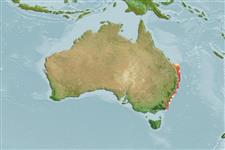
Southwest Pacific: eastern Australia (Queensland southward to New South Wales). Possibly merely an eastern subspecies, of which Herklotsichthys blackburni is the western counterpart; however, it seems equally close to Herklotsichthys Species C. Reported from lower Fly River, Papua New Guinea (Ref. 13533).
Storlek / Vikt / Ålder
Könsmognad: Lm ? range ? - ? cm
Max length : 20.0 cm SL hane/ej könsbestämd; (Ref. 33617); common length : 14.0 cm SL hane/ej könsbestämd; (Ref. 33617)
Taggstrålar i ryggfenan (totalt) : 0; Mjukstrålar i ryggfenan (totalt) : 16 - 19; Taggstrålar i analfenan: 0; Mjukstrålar i analfenan: 17 - 21; Ryggkotor: 41 - 42. Distinguished from most other Australian Herklotsichthys by lacking spots on the flank and lacking elongate wing-like scales underneath pre-dorsal scales. Most closely resembles H. blackburni but has more lower gill rakers. Separated from H. gotoi and Herklotsichthys species C by having 3 distinct dark lines upper flank. Upper caudal tip black; dorsal fin with distinct pale band.
Body shape (shape guide): fusiform / normal; Cross section: compressed.
Schooling species found in estuarine and coastal marine waters (Ref. 33617, 75154). Adults undergo spawning migration from coastal waters into upper reaches of estuaries during summer and autumn (Ref. 33617).
Livscykel och parningsbeteende
Könsmognad | Reproduktion | Lek | Ägg | Fekunditet | Larver
Whitehead, P.J.P., 1985. FAO Species Catalogue. Vol. 7. Clupeoid fishes of the world (suborder Clupeoidei). An annotated and illustrated catalogue of the herrings, sardines, pilchards, sprats, shads, anchovies and wolf-herrings. FAO Fish. Synop. 125(7/1):1-303. Rome: FAO. (Ref. 188)
Status på IUCN:s rödlista (Ref. 130435: Version 2025-2 (Global))
Hot mot människor
Harmless
Mänskliga användningsområden
Fiskeri: mindre kommeriell
Verktyg
Särskilda rapporter
Ladda ner XML
Internet-källor
Uppskattningar baserade på modeller
Önskad temperatur (Ref.
123201): 19.4 - 24.5, mean 22.5 °C (based on 24 cells).
Index för fylogenetisk mångfald (Ref.
82804): PD
50 = 0.5002 [Uniqueness, from 0.5 = low to 2.0 = high].
Bayesian length-weight: a=0.00871 (0.00414 - 0.01834), b=3.06 (2.89 - 3.23), in cm total length, based on LWR estimates for this (Sub)family-body shape (Ref.
93245).
Trofisk nivå (Ref.
69278): 3.1 ±0.3 se; based on size and trophs of closest relatives
Resiliens (Ref.
120179): Hög, lägsta populationsfördubblingstid mindre än 15 månader (Preliminary K or Fecundity.).
Sårbarhet i fisket (Ref.
59153): Low vulnerability (14 of 100).
🛈