>
Clupeiformes (Herrings) >
Dorosomatidae (Gizzard shads and sardinellas)
Etymology: Opisthonema: Greek, opisthe = behind + Greek,nema = filament (Ref. 45335).
Eponymy: Father Tomás de Berlanga (1487–1551) was the fourth Bishop of Panama (1534). [...] (Ref. 128868), visit book page.
Umwelt: Milieu / Klimazone / Tiefenbereich / Verbreitungsgebiet
Ökologie
seewasser pelagic-neritic; tiefenbereich 0 - 50 m (Ref. 188). Tropical; 3°N - 4°S, 94°W - 89°W (Ref. 188)
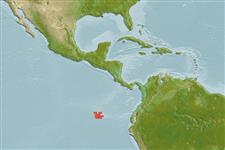
Southeast Pacific: endemic to the Galapagos Islands.
Größe / Gewicht / Alter
Geschlechtsreife: Lm ? range ? - ? cm
Max length : 26.0 cm SL Männchen/unbestimmt; (Ref. 188); common length : 18.0 cm SL Männchen/unbestimmt; (Ref. 188)
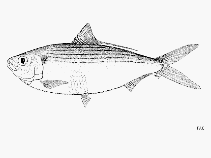
Rückenflossenstacheln (insgesamt) : 0; Rückenflossenweichstrahlen (insgesamt) : 13 - 21; Afterflossenstacheln: 0; Afterflossenweichstrahlen: 15 - 17. The filamentous last dorsal fin ray distinguishes this species from members of any other eastern Pacific clupeoid genus. Lower gill rakers 50 to 87 in fishes over 14 cm standard length (intermediate between O. medirastre with 41 to 69 and O. libertate with 63 to 110, but neither of these occur in the Galapagos Islands).
Body shape (shape guide): fusiform / normal; Cross section: compressed.
Forms schools.
Lebenszyklus und Paarungsverhalten
Geschlechtsreife | Fortpflanzung | Ablaichen | Eier | Fruchtbarkeit | Larven
Whitehead, P.J.P., 1985. FAO Species Catalogue. Vol. 7. Clupeoid fishes of the world (suborder Clupeoidei). An annotated and illustrated catalogue of the herrings, sardines, pilchards, sprats, shads, anchovies and wolf-herrings. FAO Fish. Synop. 125(7/1):1-303. Rome: FAO. (Ref. 188)
IUCN Rote Liste Status (Ref. 130435: Version 2025-2 (Global))
Bedrohung für Menschen
Harmless
Nutzung durch Menschen
Fischereien: kleinfischerei
Tools
Zusatzinformationen
Download XML
Internet Quellen
Schätzungen auf der Grundlage von Modellen
Bevorzugte Temperatur (Ref.
123201): 14.5 - 23.7, mean 19.3 °C (based on 4 cells).
Phylogenetischer Diversitätsindex (Ref.
82804): PD
50 = 0.5312 [Uniqueness, from 0.5 = low to 2.0 = high].
Bayesian length-weight: a=0.00871 (0.00414 - 0.01834), b=3.06 (2.89 - 3.23), in cm total length, based on LWR estimates for this (Sub)family-body shape (Ref.
93245).
Trophische Ebene (Ref.
69278): 3.3 ±0.4 se; based on size and trophs of closest relatives
Widerstandsfähigkeit (Ref.
120179): hoch, Verdopplung der Population dauert weniger als 15 Monate. (Preliminary K or Fecundity.).
Anfälligkeit der Fischerei (Ref.
59153): Low vulnerability (22 of 100).
🛈
Nährstoffe (Ref.
124155): Calcium = 175 [97, 371] mg/100g; Iron = 1.71 [0.94, 3.00] mg/100g; Protein = 19.2 [18.0, 20.4] %; Omega3 = 0.442 [0.231, 0.860] g/100g; Selenium = 36.6 [17.6, 89.3] μg/100g; VitaminA = 43.8 [14.7, 136.6] μg/100g; Zinc = 1.05 [0.70, 1.62] mg/100g (wet weight);