Environnement : milieu / zone climatique / profondeur / gamme de distribution
Écologie
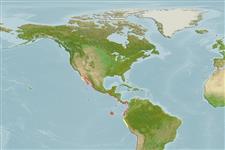
marin; saumâtre pelagic-neritic; profondeur 0 - 50 m (Ref. 188), usually 1 - 7 m (Ref. 96339). Tropical; 33°N - 17°S, 115°W - 76°W (Ref. 188)
Eastern Pacific: La Jolla, California to Peru (at least to Callao), including the Gulf of California (Ref. 35601). (This species seems to have two forms or subspecies: Harengula thrissina thrissina from the Gulf of California to Panama and Harengula thrissina peruana from Panama to Peru).
Taille / Poids / Âge
Maturité: Lm ? range ? - ? cm
Max length : 18.4 cm TL mâle / non sexé; (Ref. 96339); common length : 8.0 cm SL mâle / non sexé; (Ref. 9291)
Description synthétique
Clés d'identification | Morphologie | Morphométrie
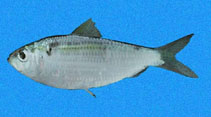
Épines dorsales (Total) : 0; Rayons mous dorsaux (Total) : 13 - 21; Épines anales: 0; Rayons mous anaux: 15 - 17. tooth plate on tongue and tooth plate behind it (basihyal and basibranchial tooth plates) broad, their width about 3 to 5 times in their combined lengths. Last dorsal fin ray not elongate (cf. Opisthonema).
Body shape (shape guide): fusiform / normal; Cross section: compressed.
A schooling species found in coastal waters. Form dense schools along shores and estuarine areas with salinities slightly lower than that of saltwater (Ref. 9291). Feed on planktonic crustaceans (Ref. 9291). Oviparous, with planktonic eggs and larvae (Ref. 35601). Utilized as bait (at least in Mexico and Costa Rica) (Ref. 9291).
Cycle de vie et comportement reproducteur
Maturité | Reproduction | Frai | Œufs | Fécondité | Larves
Whitehead, P.J.P., 1985. FAO Species Catalogue. Vol. 7. Clupeoid fishes of the world (suborder Clupeoidei). An annotated and illustrated catalogue of the herrings, sardines, pilchards, sprats, shads, anchovies and wolf-herrings. FAO Fish. Synop. 125(7/1):1-303. Rome: FAO. (Ref. 188)
Statut dans la liste rouge de l'IUCN (Ref. 130435: Version 2025-2 (Global))
Menace pour l'homme
Harmless
Utilisations par l'homme
Pêcheries: pêcheries vivrières; appât: occasionally
Outils
Articles particuliers
Télécharger en XML
Sources Internet
Estimations basées sur des modèles
Température préférée (Réf.
123201): 22.3 - 29.1, mean 26.4 °C (based on 242 cells).
Indice de diversité phylogénétique (Réf.
82804): PD
50 = 0.5625 [Uniqueness, from 0.5 = low to 2.0 = high].
Bayesian length-weight: a=0.00871 (0.00414 - 0.01834), b=3.06 (2.89 - 3.23), in cm total length, based on LWR estimates for this (Sub)family-body shape (Ref.
93245).
Niveau trophique (Réf.
69278): 3.1 ±0.30 se; based on food items.
Résilience (Réf.
120179): Haut, temps minimum de doublement de population inférieur à 15 mois (Preliminary K or Fecundity.).
Vulnérabilité de la pêche (Ref.
59153): Low vulnerability (10 of 100).
🛈
Nutriments (Ref.
124155): Calcium = 267 [139, 488] mg/100g; Iron = 2.19 [1.33, 3.63] mg/100g; Protein = 18.9 [17.8, 19.9] %; Omega3 = 0.434 [0.246, 0.764] g/100g; Selenium = 39.8 [19.8, 76.8] μg/100g; VitaminA = 31 [14, 71] μg/100g; Zinc = 1.87 [1.31, 2.71] mg/100g (wet weight);