Taxonomic Remarks
The species in the genera Spratelloides Bleeker, 1851 and Jenkinsia Jordan & Evermann, 1896 should most probably be assigned to a separated family from Clupeidae and Dussumieriidae (Lavoué, pers. comm., July 2013). See a preliminary analysis in Lavoué et al. (2013: Ref. 93878).
Milieu: milieu / Klimaatzone / Diepte / verspreidingsgebied
Ecologie
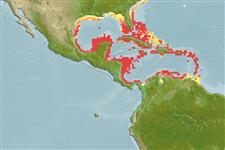
marien rifbewoner; diepte 0 - 50 m. Subtropical; 34°N - 8°N, 100°W - 60°W (Ref. 188)
Western Central Atlantic: Bermuda, Florida (USA), Gulf of Mexico and Caribbean south to Tobago. Antilles (Ref. 26938).
Lengte bij maturiteit / Grootte / Gewicht / Leeftijd
Maturiteit: Lm 2.8, range 2 - ? cm
Max length : 7.5 cm TL mannelijk / geslacht onbekend; (Ref. 9710)
Dorsale stekels (totaal) : 0; Anale stekels: 0; Wervels: 40 - 43. Lower gill raker counts, show some correlation with geographical area, suggesting that the species may comprise three races or subspecies. W-shaped pelvic scute; pre-maxillae toothed, 1 supra-maxilla; isthmus slender, but with slight 'shoulders' anteriorly; vertebrae 40 to 43 (usually 42 - Venezuela); silver lateral band not becoming narrower or fading near gill opening (Ref. 188). Chest is slightly keeled. Small anal fin. Faintly greenish above (Ref. 37032).
Body shape (shape guide): fusiform / normal; Cross section: oval.
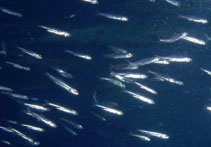
A schooling species usually occurring inshore. Feeds on zooplankton. Preyed upon by many larger fishes and squids (Ref. 5521). Important as live bait for scombrids (Ref. 26340). In 1937, at Kingston, Jamaica it spawns during the winter months. Travels long distance (Ref. 37032).
Levenscyclus en paargedrag
Maturiteit | Voortplanting | Paaien | Eieren | Fecunditeit | Larven
Whitehead, P.J.P., 1985. FAO Species Catalogue. Vol. 7. Clupeoid fishes of the world (suborder Clupeoidei). An annotated and illustrated catalogue of the herrings, sardines, pilchards, sprats, shads, anchovies and wolf-herrings. FAO Fish. Synop. 125(7/1):1-303. Rome: FAO. (Ref. 188)
Status op de Rode Lijst van het IUCN (Ref. 130435: Version 2025-2 (Global))
Gevaar voor de mens
Harmless
Gebruik door de mens
Visserij: van minder commercieel belang; aas: usually
Tools
Speciale rapporten
Download XML
Internetbronnen
Schattingen op basis van modellen
Gewenste temperatuur (Ref.
123201): 24.4 - 28, mean 26.8 °C (based on 200 cells).
Fylogenetische diversiteitsindex (Ref.
82804): PD
50 = 0.5664 [Uniqueness, from 0.5 = low to 2.0 = high].
Bayesian length-weight: a=0.00692 (0.00360 - 0.01331), b=3.26 (3.09 - 3.43), in cm total length, based on LWR estimates for this species & (Sub)family-body (Ref.
93245).
Trofisch niveau (Ref.
69278): 3.3 ±0.3 se; based on diet studies.
Generation time: 0.3 ( na - na) years. Estimated as median ln(3)/K based on 1
growth studies.
Weerstandsvermogen (Ref.
120179): Hoog, minimale populatieverdubbelingstijd minder dan 15 maanden (tm<1; K>0.3).
Kwetsbaarheid van de visserij (Ref.
59153): Low vulnerability (10 of 100).
🛈
Voedingsstoffen (Ref.
124155): Calcium = 177 [73, 638] mg/100g; Iron = 2.61 [0.98, 5.72] mg/100g; Protein = 19.7 [17.9, 21.3] %; Omega3 = 0.356 [0.102, 1.308] g/100g; Selenium = 34 [9, 124] μg/100g; VitaminA = 26.6 [4.9, 168.4] μg/100g; Zinc = 2.25 [1.12, 4.22] mg/100g (wet weight);