Entorno: milieu / zona climática / rango de profundidad / gama de distribución
Ecología
marino; salobre pelagic-neritic; rango de profundidad 0 - 20 m (Ref. 6390). Temperate; 27°S - 44°S
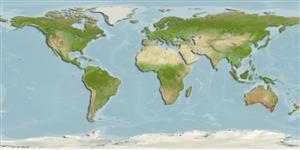
Eastern Indian Ocean: Endemic to Australian temperate waters (Murchison River, Kalbarri in Western Australia to Eden, New South Wales, including Tasmania).
Longitud en la primera madurez / Tamaño / Peso / Edad
Madurez: Lm ?, range 25 - ? cm
Max length : 52.0 cm SL macho / no sexado; (Ref. 10988); peso máximo publicado: 600.00 g (Ref. 6390); edad máxima reportada: 10 años (Ref. 27011)
Descripción breve
Claves de identificación | Morfología | Morfometría
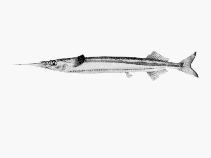
Espinas dorsales (total) : 0; Radios blandos dorsales (total) : 15 - 18; Espinas anales: 0; Radios blandos anales: 17 - 20; Vértebra: 55 - 61. Gill rakers usually 33 or less on the first arch and usually 26 or less on the second arch. Relatively shorter upper and lower jaw, especially at larger sizes.
Body shape (shape guide): elongated.
Found inshore in surface waters of estuaries, bays, inlets and gulfs to a depth of about 20 m (Ref. 9563). In the South Australian gulfs, southern sea garfish may be found in deeper waters during the colder months (Ref. 27008). Generally herbivorous, seagrasses and algal filaments comprise about 75% of their food (Refs. 26551, 27013). Form schools, generally found near the surface at night and close to the bottom over seagrass beds during the day (Ref. 6390). Post-larvae or young fish less than 1-year-old live in estuaries from March to July then move to inshore marine waters, remaining there for up to 2 years (Ref. 27012).
Also Ref 101194.
Collette, B.B., 1974. The garfishes (Hemiramphidae) of Australia and New Zealand. Records of the Australian Museum 29(2):11-105. (Ref. 10988)
Situación en la Lista Roja de la UICN (Ref. 130435: Version 2025-2 (Global))
Amenaza para el ser humano
Harmless
Usos humanos
Pesquerías: comercial; carnada: usually
Herramientas
Informes especiales
Descargar XML
Fuentes de Internet
Estimaciones basadas en modelos
Temperatura preferida (Referencia
123201): 14.3 - 22.3, mean 17.6 °C (based on 324 cells).
Índice de diversidad filogenética (Referencia
82804): PD
50 = 0.5000 [Uniqueness, from 0.5 = low to 2.0 = high].
Bayesian length-weight: a=0.00257 (0.00116 - 0.00571), b=3.09 (2.92 - 3.26), in cm total length, based on LWR estimates for this Genus-body shape (Ref.
93245).
Nivel trófico (Referencia
69278): 2.7 ±0.27 se; based on food items.
Resiliencia (Referencia
120179): Medio, población duplicada en un tiempo mínimo de 1.4-4.4 años (K=0.51-0.77; tm=2-3; tmax=10).
Vulnerabilidad pesquera (Ref.
59153): Low to moderate vulnerability (28 of 100).
🛈