>
Gobiiformes (Gobies) >
Gobiidae (Gobies) > Gobionellinae
Etymology: Knipowitschia: Because of N.M.Knipowitsch, a zoologist and Russian ichthyologist from the Academy of Sciences. Expeditions in "Pomor" and "Pervosvanniy" ships to Azov and Black sea (1898-1908).
Eponymy: Nikolai Mikhailovich Knipovich (also given as Knipowitsch) (1862–1939) was a Russian oceanographer, marine zoologist and ichthyologist. [...] (Ref. 128868), visit book page.
More on author: Berg.
Taxonomic Remarks
Kavraiskii 1916 is a nomen nudum (M. Kottelat, pers. comm.)
Ambiente: milieu / zona climatica / distribuzione batimetrica / gamma di distribuzione
Ecologia
marino; acqua dolce; salmastro demersale; amfidromo (Ref. 46888); distribuzione batimetrica 0 - 2 m (Ref. 12215). Temperate; 47°N - 38°N, 12°E - 61°E
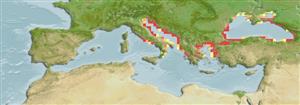
Eurasia: along the coasts of Black, Azov, Caspian and Aegean seas west to Aliakmon drainage (Greece). Identity of the population along the eastern shore of Adriatic is questionable. Introduced in the Aral Sea and is now extirpated.
Lunghezza alla prima maturità / Dimensione / Peso / Età
Maturità: Lm 2.2, range 2 - 2.3 cm
Max length : 5.0 cm TL maschio/sesso non determinato; (Ref. 4696); Età massima riportata: 2.00 anni (Ref. 126411)
Breve descrizione
Chiavi di identificazione | Morfologia | Morfometria
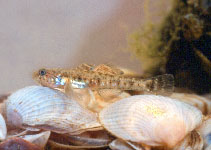
Spine dorsali (totale) : 7; Raggi dorsali molli (totale) : 7 - 8; Spine anali: 1; Raggi anali molli: 7 - 9; Vertebre: 31 - 32. Anterior oculoscapular, preopercular, and sometimes posterior oculoscapular, canals present; body squamation complete on caudal peduncle and along at least lateral midline to axil. Males with 4-5 major vertical bars.
Body shape (shape guide): elongated.
Inhabit fresh to hyper-saline waters (to 55 ppt) of lakes, estuaries and lagoons, in shallow areas with much weed. Feed on small crustaceans and chironomid larvae (Ref.12215); larvae of the mussel Dreissena polymorpha (Ref. 59043). Lives less than 2 years. Spawns after first winter. Eggs are attached to the roof of a cavity under stones, plant material or shells and are defended by male. Postlarvae are pelagic. (Ref.59043).
Ciclo vitale e comportamento di accoppiamento
Maturità | Riproduzione | Deposizione | Uova | Fecondità | Larve
Spawns up to 4 portions of eggs (Ref. 59043).
Miller, P.J., 1986. Gobiidae. p. 1019-1085. In P.J.P. Whitehead, M.-L. Bauchot, J.-C. Hureau, J. Nielsen and E. Tortonese (eds.) Fishes of the North-eastern Atlantic and the Mediterranean. Volume 3. UNESCO, Paris. (Ref. 4696)
Stato della Lista Rossa IUCN (Ref. 130435: Version 2025-2 (Global))
Minaccia per l'uomo
Harmless
Usi umani
Strumenti
Rapporti speciali
Scarica XML
Fonti Internet
Stime basate su modelli
Temperatura preferita (Fonte Biblio.
123201): 14.4 - 18.7, mean 17.6 °C (based on 188 cells).
Indice di diversità filogenetica (Fonte Biblio.
82804): PD
50 = 0.5000 [Uniqueness, from 0.5 = low to 2.0 = high].
Bayesian length-weight: a=0.00724 (0.00627 - 0.00837), b=3.06 (3.02 - 3.10), in cm total length, based on LWR estimates for this species (Ref.
93245).
Livello trofico (Fonte Biblio.
69278): 3.3 ±0.45 se; based on food items.
Generation time: 0.7 ( na - na) years. Estimated as median ln(3)/K based on 1
growth studies.
Resilienza (Fonte Biblio.
120179): Alto, tempo minimo di raddoppiamento della popolazione meno di 15 mesi (Preliminary K or Fecundity.).
Vulnerabilità della pesca (Ref.
59153): Low vulnerability (10 of 100).
🛈