>
Scombriformes (Mackerels) >
Scombridae (Mackerels, tunas, bonitos) > Scombrinae
Etymology: Thunnus: Greek, thynnos = tunna (Ref. 45335).
Eponymy: Sir Frederick McCoy (1817–1899) was an Irish paleontologist and naturalist. [...] (Ref. 128868), visit book page.
More on author: Castelnau.
สิ่งแวดล้อม : สิ่งแวดล้อม / เขตภูมิอากาศ / ระดับความลึก / ระยะการกระจายสินค้า
นิเวศวิทยา
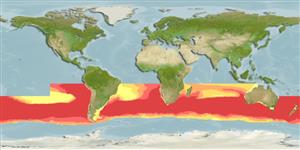
เกี่ยวกับทะเล,น้ำเค็ม pelagic-oceanic; สัตว์น้ำที่อาศัยและอพยพภายในทะเลเท่านั้น (Ref. 71039); ระดับความลึก 0 - 2743 m (Ref. 57178). Temperate; 5°C - 20°C (Ref. 168); 10°S - 60°S, 180°W - 180°E (Ref. 54921)
Atlantic, Indian and Pacific: temperate and cold seas, mainly between 30°S and 50°S, to nearly 60°S. During spawning, large fish migrate to tropical seas, off the west coast of Australia, up to 10°S. Highly migratory species. If the current exploitation continues, the population will be below 500 mature individuals in 100 years (Ref. 27905).
ความยาวเมื่อครบกำหนดครั้งแรก / ขนาด / น้ำหนัก / อายุ
วัยเจริญพันธุ์: Lm 122.0, range 120 - 130 cm
Max length : 245 cm FL เพศผู้/กระเทย; (Ref. 5203); common length : 160 cm FL เพศผู้/กระเทย; (Ref. 9684); น้ำหนักสูงสุดที่มีการรายงาน: 260.0 kg (Ref. 5203); อายุสูงสุดที่ได้รายงาน: 20 ปี (Ref. 168)
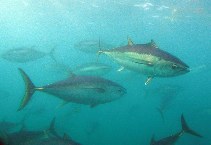
สัตว์มีกระดูกสันหลัง: 39. A very large species, deepest near the middle of the first dorsal fin base. Swim bladder present. Lower sides and belly silvery white with colorless transverse lines alternating with rows of colorless dots. The first dorsal fin is yellow or bluish; the anal fin and finlets are dusky yellow edged with black; the median caudal keel is yellow in adults.
Body shape (shape guide): fusiform / normal; Cross section: oval.
By maturity, most southern bluefin tuna lead an oceanic, pelagic existence (Ref. 6390). Spawning fish and larvae are encountered in waters with surface temperatures between 20° and 30°C. An opportunistic feeder, preying on a wide variety of fishes, crustaceans, cephalopods, salps, and other marine animals. Mostly canned (Ref. 9684). A specialized fishery for sashimi-quality has been developed recently by New Zealand fishers. In Japan, it is highly prized for the sashimi markets.
It is not known whether all mature fish spawn each year, every few years, or even only once in their lifetime (Ref. 30320).
Collette, B.B. and C.E. Nauen, 1983. FAO Species Catalogue. Vol. 2. Scombrids of the world. An annotated and illustrated catalogue of tunas, mackerels, bonitos and related species known to date. Rome: FAO. FAO Fish. Synop. 125(2):137 p. (Ref. 168)
สถานะบัญชีแดงของ IUCN (Ref. 130435: Version 2025-2 (Global))
ภัยคุกคามต่อมนุษย์
Harmless
การใช้ของมนุษย์
การประมง: การค้า; การเพาะเลี้ยงสัตว์น้ำ: การค้า; การตกปลาเป็นกีฬา: ใช่
เครื่องมือ
รายงานพิเศษ
ดาวน์โหลด XML
แหล่งที่มาจากอินเตอร์เน็ต
การประมาณค่าตามแบบจำลอง
อุณหภูมิที่ต้องการ (อ้างอิง
123201): 2.5 - 7.9, mean 5 °C (based on 439 cells).
ดัชนีความหลากหลายทางวิวัฒนาการ (อ้างอิง
82804): PD
50 = 0.5039 [Uniqueness, from 0.5 = low to 2.0 = high].
Bayesian length-weight: a=0.01288 (0.01070 - 0.01552), b=3.03 (3.00 - 3.06), in cm total length, based on LWR estimates for this species (Ref.
93245).
ระดับชั้นอาหาร (อ้างอิง
69278): 3.9 ±0.53 se; based on food items.
ความสามารถในการกลับคืนสู่ปกติ (อ้างอิง
120179): ต่ำ, เวลาต่ำสุดที่จะทำให้ประชากรเพิ่มขึ้นเป็น 2 เท่าใช้เวลา 4.5 - 14 ปี (K=0.14-0.15; tm=8-9; tmax=20; Fec=14 million).
Prior r = 0.27, 95% CL = 0.18 - 0.41, Based on 1 full stock assessment.
ความเสี่ยงต่อการตกปลา (Ref.
59153): High to very high vulnerability (67 of 100).
🛈
ความเสี่ยงต่อสภาพภูมิอากาศ (Ref.
125649): Moderate vulnerability (38 of 100).
🛈
สารอาหาร (Ref.
124155): Calcium = 9.89 [5.80, 19.12] mg/100g; Iron = 0.922 [0.355, 2.441] mg/100g; Protein = 23.2 [21.7, 24.6] %; Omega3 = 0.74 [0.44, 1.24] g/100g; Selenium = 31.2 [8.4, 97.4] μg/100g; VitaminA = 22 [3, 199] μg/100g; Zinc = 0.245 [0.131, 0.490] mg/100g (wet weight);