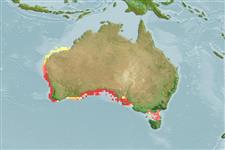
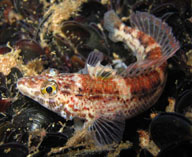
Milieu: milieu / Klimaatzone / Diepte / verspreidingsgebied
Ecologie
marien rifbewoner; diepte 1 - 35 m (Ref. 9563). Subtropical
Eastern Indian Ocean: southern Western Australia and South Australia.
Grootte / Gewicht / Leeftijd
Maturiteit: Lm ? range ? - ? cm
Max length : 10.0 cm TL mannelijk / geslacht onbekend; (Ref. 9563)
Korte beschrijving
Determinatiesleutels | Morfologie | Morfometrie
Dorsale stekels (totaal) : 5; Dorsale zachte stralen (totaal) : 21 - 22; Anale stekels: 1; Anale zachte stralen: 17 - 18. This species is characterized by the following: D V,21-22 (rarely 21); A I,17-18 (rarely 17); 13-15 pectoral rays; 47-53 lateral-line scales; about 3 + 8 gill rakers; 3-4 predorsal scales, ending in a median naked area on nape with rest of nape scaled, the scales extending into posterior interorbital space and continuing in a single row to front of interorbital; ctenoid scales on nape and cheek; front of lower jaw with 10 canine teeth; with palatine teeth; upper edge of subopercle with a prominent sharp spine; vertical edge of preopercle serrate to irregular; body depth 4.45-5.35 in SL (18.7-22.6% SL); middle dorsal spine longest, 7.05-8.9% SL; truncate to slightly rounded caudal fin, 19.2-21.3% SL; membrane from last dorsal spine joined to base of first soft ray; whitish body with a straight to wavy black stripe from behind eye to upper base of caudal fin (stripe may be broken into blotches, especially on head); ventral half of body with a series of 10 dark bars; a broad median brown band on upper lip and two spots on side of lip; a long dark brown streak on side of lower lip; a large black spot basally in dorsal fin between spines II and V; soft portion of dorsal fin is pale with a small blackish spot at base of most rays, and 1-2 outer rows of small black spots on membranes; pale anal fin with a row of faint blackish spots at base of most rays and a middle row of small dark spots; pale caudal fin with a dusky lower margin (Ref. 57562).
Body shape (shape guide): elongated.
Found on coastal reefs (Ref. 9563). A small territorial fish found in protected sandy and muddy areas near reefs and rocky outcrops from the shallows to depths of just over 35 m (Ref. 33839).
Levenscyclus en paargedrag
Maturiteit | Voortplanting | Paaien | Eieren | Fecunditeit | Larven
May, J.L. and J.G.H. Maxwell, 1986. Trawl fish from temperate waters of Australia. CSIRO Division of Fisheries Research, Tasmania. 492 p. (Ref. 9563)
Status op de Rode Lijst van het IUCN (Ref. 130435: Version 2025-2 (Global))
Gevaar voor de mens
Harmless
Gebruik door de mens
Tools
Speciale rapporten
Download XML
Internetbronnen
Schattingen op basis van modellen
Gewenste temperatuur (Ref.
123201): 15.2 - 22.8, mean 17.7 °C (based on 212 cells).
Fylogenetische diversiteitsindex (Ref.
82804): PD
50 = 0.5000 [Uniqueness, from 0.5 = low to 2.0 = high].
Bayesian length-weight: a=0.00692 (0.00314 - 0.01524), b=3.06 (2.88 - 3.24), in cm total length, based on LWR estimates for this Genus-body shape (Ref.
93245).
Trofisch niveau (Ref.
69278): 3.4 ±0.4 se; based on size and trophs of closest relatives
Weerstandsvermogen (Ref.
120179): Hoog, minimale populatieverdubbelingstijd minder dan 15 maanden (Preliminary K or Fecundity.).
Kwetsbaarheid van de visserij (Ref.
59153): Low vulnerability (10 of 100).
🛈
Voedingsstoffen (Ref.
124155): Calcium = 97 [41, 205] mg/100g; Iron = 0.873 [0.457, 1.605] mg/100g; Protein = 18.7 [16.4, 20.8] %; Omega3 = 0.164 [0.084, 0.313] g/100g; Selenium = 13.9 [5.5, 32.3] μg/100g; VitaminA = 65.3 [18.2, 241.9] μg/100g; Zinc = 1.31 [0.77, 2.08] mg/100g (wet weight);