Environnement : milieu / zone climatique / profondeur / gamme de distribution
Écologie
marin; saumâtre démersal; amphidrome (Ref. 51243). Tropical
Indian Ocean: southern India and probably most other parts of the Indian Ocean.
Taille / Poids / Âge
Maturité: Lm ? range ? - ? cm
Max length : 30.0 cm TL mâle / non sexé; (Ref. 7245); common length : 20.0 cm TL mâle / non sexé; (Ref. 7245)
Description synthétique
Clés d'identification | Morphologie | Morphométrie
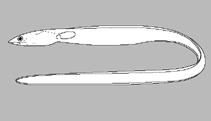
Vertèbres: 126 - 130. Body elongate, more or less cylindrical, slightly compressed, with a hard tail; sharply conical head; anterior nostril a downwardly facing tube near tip of snout, posterior nostril an inconspicuous slit in upper lip, guarded by a papilla; eyes very small, inconspicuous; mouth large, extending well behind eye; small, sharp, more or less uniserial teeth; gill opening a longitudinal slit beneath throat with an extra fold of skin alongside; dorsal fin origin over gill-opening; very poorly developed dorsal and anal fins (Ref. 4832).
Body shape (shape guide): eel-like.
Inhabits estuaries and inshore areas of turbid waters. Marketed fresh and used mainly for bait.
Cycle de vie et comportement reproducteur
Maturité | Reproduction | Frai | Œufs | Fécondité | Larves
Castle, P.H.J., 1984. Ophichthidae. In W. Fischer and G. Bianchi (eds.) FAO species identification sheets for fishery purposes. Western Indian Ocean (Fishing Area 51). Volume 3. FAO, Rome. (Ref. 7245)
Statut dans la liste rouge de l'IUCN (Ref. 130435: Version 2025-2 (Global))
Menace pour l'homme
Harmless
Utilisations par l'homme
Pêcheries: sans intérêt; appât: usually
Outils
Articles particuliers
Télécharger en XML
Sources Internet
Estimations basées sur des modèles
Indice de diversité phylogénétique (Réf.
82804): PD
50 = 0.7500 [Uniqueness, from 0.5 = low to 2.0 = high].
Bayesian length-weight: a=0.00093 (0.00041 - 0.00214), b=2.99 (2.79 - 3.19), in cm total length, based on LWR estimates for this (Sub)family-body shape (Ref.
93245).
Niveau trophique (Réf.
69278): 3.6 ±0.6 se; based on size and trophs of closest relatives
Résilience (Réf.
120179): Haut, temps minimum de doublement de population inférieur à 15 mois (Preliminary K or Fecundity.).
Vulnérabilité de la pêche (Ref.
59153): Low vulnerability (20 of 100).
🛈