>
Cichliformes (Cichlids, convict blennies) >
Cichlidae (Cichlids) > Pseudocrenilabrinae
Etymology: Oreochromis: Latin, aurum = gold + Greek, chromis = a fish, perhaps a perch (Ref. 45335).
More on author: Boulenger.
Ambiente: milieu / zona climatica / distribuzione batimetrica / gamma di distribuzione
Ecologia
; acqua dolce; salmastro benthopelagico. Tropical; 23°C - 42°C (Ref. 670); 13°S - 17°S
Africa: Two subspecies are recognized: Oreochromis shiranus shiranus from Shiré River above the Murchison rapids and Lake Malawi, together with their tributaries in Tanzania, Malawi and Mozambique (Ref. 5166, 118630); Oreochromis shiranus chilwae from Lake Chilwa and its basin in Malawi and Mozambique (Ref. 5166, 118638).
Lunghezza alla prima maturità / Dimensione / Peso / Età
Maturità: Lm 13.5, range 17 - ? cm
Max length : 39.0 cm SL maschio/sesso non determinato; (Ref. 21)
Breve descrizione
Chiavi di identificazione | Morfologia | Morfometria
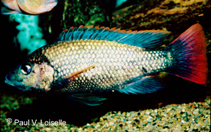
Spine dorsali (totale) : 15 - 18; Raggi dorsali molli (totale) : 10 - 13; Spine anali: 3 - 5; Raggi anali molli: 9 - 11; Vertebre: 29 - 30. Diagnosis: A large, deep-bodied species with 4, rarely 3 or 5, anal fin spines (Ref. 118638). Females and immatures from the Lake Malawi catchment have a dark olive-coloured body, yellow-gold below; other populations, such as those from Lakes Chilwa and Chiuta and the Ruvuma system show a more silvery colour; unusually for Oreochromis, the horizontal stripes are often more prominent than the vertical bars; adult males develop very large jaws and a concave head profile, they are black, with red margins to the dorsal and caudal fins (Ref. 118638). Underwater or in aquaria, males show numerous white spots on the upper half of the flanks, but these fade quickly under stress, so that they appear uniformly black when removed from the water (Ref. 118638).
Body shape (shape guide): fusiform / normal; Cross section: compressed.
Found in very shallow waters around Lake Malawi that are densely vegetated, but also in lagoons (Ref. 5595). It can occur at temperatures ranging from 23.0-42.0 °C (Ref. 670). It feeds on detritus and phytoplankton (Ref. 5595). A maternal mouthbrooder (Ref. 118638). A large species heavily exploited in Lake Nyasa [= Lake Malawi] and its catchment; males in particular are fast-growing and the species is cultured commercially in Malawi in cages and ponds (Ref. 118638).
A maternal mouthbrooder (Ref. 118638). Builds basin-shaped nests in shallow water from 0.15 m to 1.5 m deep, in sand overlaid with mud, in the vicinity of rooted aquatic vegetation; females brood eggs and young in the mouth until the young reach a length of about 10 mm (Ref. 670).
Trewavas, E. and G.G. Teugels, 1991. Oreochromis. p. 307-346. In J. Daget, J.-P. Gosse, G.G. Teugels and D.F.E. Thys van den Audenaerde (eds.) Checklist of the freshwater fishes of Africa (CLOFFA). ISNB, Brussels; MRAC, Tervuren; and ORSTOM, Paris. Vol. 4. (Ref. 5166)
Stato della Lista Rossa IUCN (Ref. 130435: Version 2025-2 (Global))
Minaccia per l'uomo
Harmless
Usi umani
Pesca: commerciale; Acquacoltura: commerciale; Acquario: Commerciale
Strumenti
Rapporti speciali
Scarica XML
Fonti Internet
Stime basate su modelli
Indice di diversità filogenetica (Fonte Biblio.
82804): PD
50 = 0.5000 [Uniqueness, from 0.5 = low to 2.0 = high].
Bayesian length-weight: a=0.01230 (0.00732 - 0.02067), b=2.99 (2.85 - 3.13), in cm total length, based on LWR estimates for this species & Genus-body shape (Ref.
93245).
Livello trofico (Fonte Biblio.
69278): 2.0 ±0.00 se; based on food items.
Resilienza (Fonte Biblio.
120179): Medio, tempo minimo di raddoppiamento della popolazione 1.4 - 4.4 anni (K=0.27-0.32).
Vulnerabilità della pesca (Ref.
59153): Low to moderate vulnerability (27 of 100).
🛈
Nutrienti (Ref.
124155): Calcium = 23.3 [8.7, 108.4] mg/100g; Iron = 1.17 [0.57, 2.60] mg/100g; Protein = 17.9 [16.3, 19.6] %; Omega3 = 0.216 [0.110, 0.458] g/100g; Selenium = 60 [31, 117] μg/100g; VitaminA = 8.08 [1.97, 29.53] μg/100g; Zinc = 1.86 [1.09, 4.32] mg/100g (wet weight);