>
Perciformes/Scorpaenoidei (Scorpionfishes) >
Neosebastidae (Gurnard scorpionfishes)
Etymology: Neosebastes: Greek, neos = new + Greek, sebastes = august, venerable (Ref. 45335).
Eponymy: Admiral Baron Hyacinthe Yves Philippe Potentien de Bouganville (1781–1846) was a French naval officer in command of the corvette ‘Espérance’. [...] (Ref. 128868), visit book page.
More on author: Cuvier.
Ambiente: milieu / zona climatica / distribuzione batimetrica / gamma di distribuzione
Ecologia
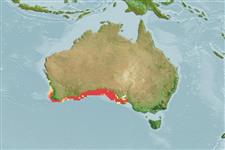
marino associati a barriera corallina; distribuzione batimetrica 10 - 100 m (Ref. 9563). Temperate; 29°S - 36°S
Eastern Indian Ocean: endemic to Australia.
Dimensione / Peso / Età
Maturità: Lm ? range ? - ? cm
Max length : 40.0 cm TL maschio/sesso non determinato; (Ref. 33839)
Breve descrizione
Chiavi di identificazione | Morfologia | Morfometria
Spine dorsali (totale) : 8; Raggi dorsali molli (totale) : 8; Spine anali: 3; Raggi anali molli: 5. Diagnosis: Dorsal rays XIII, 8 (9 in 1 of 20 specimens), third spine longest. Anal rays III, 5. Pectoral rays 20 or 21 (mode 21; 18 in 1 of 20 specimens), distal margin bilobed. Pored lateral-line scales 33-38 (34); longitudinal scale series 62-69 (66); scale rows between base of last dorsal spine and lateral line 7 or 8 (8). Well-developed gill rakers on upper limb 0 or 1 (1), lower limb 5-7 (6), total 5-8 (7); rudimentary gill rakers on upper limb 3-5 (4), lower limb 3-6 (5). Swim bladder absent. Dorsal profile of snout not steep, forming angle of about 50-55° to horizontal axis of head and body. Nasal spine simple (sometimes with 2 points), directed upward or slightly backward, length of former greater than anterior nostril diameter. Posterior margin of premaxilla ascending process extending beyond level of middle of posterior nostril when mouth closed. Interorbital ridge distinct; no scales on midinterorbital space or posterior half of supraorbital, but large and prominent on anterior half of supraorbital above interorbital ridge and on distal margin of supraorbital bone. Interorbital space extremely deep, but only about one-eighth of orbit extending above dorsal profile of head. Preocular with a small simple spine, its length less than that of nasal spine. Supraocular ridge with 3-6 prominent pointed spines, not strongly canted laterally; middle part of supraocular ridge located about midway between interorbital ridge and orbit in dorsal view. Sphenotic with a large spine and 3-7 minute spines. Postorbital spine flattened and serrated. Long, narrow and extremely deep transversal occipital pit, not covered with scales; a cluster of irregular scales protruding along front and behind sides of occipital pit; occipital pit curved posteriorly behind orbit, not covered with scales. Nuchal and supracleithral spines simple. Pterotic spine usually simple (sometimes with 2 points), originating slightly posterior to nuchal spine, base slightly smaller than that of latter. Upper posttemporal spine flattened, smooth or serrated; lower posttemporal spine simple (rarely with 2 points). Posterior margin of maxilla not extending beyond a vertical at posterior margin of pupil. Maxilla with scales extending from below posterior edge of anterior lacrimal spine to posterior margin of maxilla. Underside of mandible with 3 distinct pores and longitudinal ridges on each side, including an inner ridge extending from under lower jaw lip to lower edge of opercle, an outer ridge extending to lower edge of preopercle, and a central ridge extending to posterior part of angular and bearing the third pore posteriorly; distinct lacrimal ridge with 1-4 points. Anterior lacrimal spine usually simple (anterior edge sometimes serrated), directed ventroposteriorly (rarely forward). Posterior lacrimal spine with 1 or 2 points, directed ventroposteriorly; length of anterior lacrimal spine 2 times or less in that of posterior lacrimal spine. Suborbital pit present, front rimmed by a vertical (sometimes oblique) ridge on lacrimal to ventroanterior margin of orbit; large scales on entire suborbital pit. Suborbital ridge with 3-6 pointed spines in line with lacrimal ridge, spines joined at bases, directed backward. no scales between ventral margin of orbit and suborbital ridge, or on eye membrane. Preopercle with 5 spines, 4 lower spines simple, lacking a median ridge, uppermost spine with a median ridge and with a spine (rarely 2 spines) distally; length of uppermost preopercular spine slightly greater than or approximately equal to pupil diameter. Upper opercular spine simple, no median ridge; lower opercular spine simple with a median ridge; tip of lower opercular spine usually not extending beyond (rarely extending slightly beyond) opercular margin (Ref. 54394).
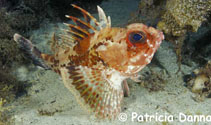
Body reddish brown, with large darker brown patch beneath dorsal fin anteriorly and smaller patches on dorsal half of body posteriorly; lower part of body with irregular orange spots; depth 35-39% SL. Head large 41-46%SL; eyes large 31-37%HL, protruding only slightly above dorsal profile. Caudal fin 13 (Ref. 33839). Lateral line almost straight, lacking the short curve at origin (Ref. 12723).
Body shape (shape guide): short and / or deep; Cross section: compressed.
A temperate species found inshore on reefs (Ref. 7300).
Ciclo vitale e comportamento di accoppiamento
Maturità | Riproduzione | Deposizione | Uova | Fecondità | Larve
Motomura, H., 2003. Revision of the scorpionfish genus Neosebastes (Scorpaeniformes: Neosebastidae), with descriptions of five new species. Indo-Pac. Fish. (37):46 p. (Ref. 54394)
Stato della Lista Rossa IUCN (Ref. 130435: Version 2025-2 (Global))
Usi umani
Strumenti
Rapporti speciali
Scarica XML
Fonti Internet
Stime basate su modelli
Temperatura preferita (Fonte Biblio.
123201): 17 - 18.7, mean 18 °C (based on 106 cells).
Indice di diversità filogenetica (Fonte Biblio.
82804): PD
50 = 0.5002 [Uniqueness, from 0.5 = low to 2.0 = high].
Bayesian length-weight: a=0.01995 (0.00906 - 0.04395), b=3.01 (2.83 - 3.19), in cm total length, based on all LWR estimates for this body shape (Ref.
93245).
Livello trofico (Fonte Biblio.
69278): 3.8 ±0.4 se; based on size and trophs of closest relatives
Vulnerabilità della pesca (Ref.
59153): Low to moderate vulnerability (30 of 100).
🛈
Nutrienti (Ref.
124155): Calcium = 15.3 [6.3, 32.1] mg/100g; Iron = 0.203 [0.095, 0.400] mg/100g; Protein = 17.8 [16.2, 19.4] %; Omega3 = 0.402 [0.165, 1.321] g/100g; Selenium = 9.84 [4.39, 23.28] μg/100g; VitaminA = 36.4 [8.2, 176.0] μg/100g; Zinc = 0.537 [0.343, 0.847] mg/100g (wet weight);