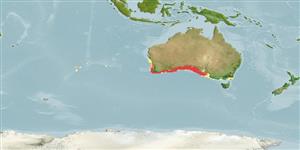
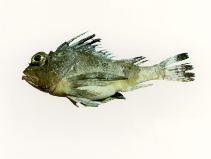
Lingkungan: lingkungan / zona iklim / kisaran kedalaman / jangkauan distribusi
Ekologi
laut berasosiasi dengan karang; kisaran kedalaman 15 - 593 m (Ref. 54394), usually 50 - 200 m (Ref. 33839). Subtropical; 28°S - 39°S
Eastern Indian Ocean: southern and southwestern coasts of Australia.
Ukuran / Berat / umur
Kematangan: Lm ? range ? - ? cm
Max length : 50.0 cm TL jantan/; (Ref. 9563)
deskripsi pendek
Kunci identifiaksi (pengenalan) | Morfologi | Morfometrik
Duri punggung (Keseluruhan (total)) : 8; duri punggung lunak (Keseluruhan (total)) : 8 - 9; Duri dubur: 3; Sirip dubur lunak: 5; vertebrata, bertulang belakang: 26. Diagnosis: Dorsal fin XIII, 8 (9 in 1 of 56 specimens), third spine longest. Anal rays III, 5. Pectoral rays 20-23 (mode 21), distal margin rounded. Pored lateral-line scales 36-43 (40); longitudinal scale series 60-72 (62); scale rows between base of last dorsal spine and lateral line 5-7 (6). Well-developed gill rakers on upper limb 0 or 1 (1), lower limb 4-7 (6), total 5-8 (7); rudimentary gill rakers on upper limb 3-5 (4), lower limb 4-8 (5). Swim bladder weakly bilobed anteriorly and posteriorly, lobes separated by a concavity (length 16% of SL, width 13% of SL). Dorsal profile of snout steep, forming angle of about 65-750 to horizontal axis of head and body. Nasal spine simple, directed upward or slightly forward, length of former approximately equal to or slightly greater than anterior nostril diameter. Posterior margin of premaxilla ascending process reaching or extending slightly beyond level of anterior margin of posterior nostril when mouth closed. Interorbital ridge indistinct; no scales on mid interorbital space, but small embedded scales present on supraorbital above interorbital ridge; interorbital space extremely deep, about one-third to a half of orbit extending above dorsal profile of head. Preocular with a small simple spine, its length less than that of nasal spine. Supraocular ridge with 3-11 pointed spines (sometimes serrated), canted laterally; supraocular ridge much closer to orbit than interorbital ridge in dorsal view; preocular and supraocular spines indistinct in larger specimens. Sphenotic with 3-13 minute pointed spines. Postorbital spine flattened and serrated. Long, narrow and extremely deep transversal occipital pit, not covered with scales. Nuchal and pterotic spines simple (sometimes pterotic spine with 2-4 points), distal margins serrated or smooth; origin of pterotic spine slightly posterior to that of nuchal spine, base slightly smaller than or equal to that of latter. Upper posttemporal spine flattened and serrated; lower posttemporal spine simple (sometimes with 2 points). Supracleithral spine simple. Posterior margin of maxilla not reaching a vertical at posterior margin of orbit; maxilla with scales extending posteriorly from between anterior and posterior lacrimal spines, but no scales on posterior margin. Underside of mandible smooth with 3 distinct pores on each side. Lacrimal ridge distinct with 1-6 points, sometimes smooth; anterior lacrimal spine simple (sometimes with 2 points), directed downward; posterior lacrimal spine with 2-5 points, directed ventroposteriorly; length of anterior lacrimal spine 2 times or more in that of posterior lacrimal spine. Suborbital pit present, front rimmed by a vertical (sometimes oblique) ridge on lacrimal to ventroanterior margin of orbit; no scales on anterior part of suborbital pit; suborbital ridge with 2 pointed spines in line with lacrimal ridge, spines separated at bases, directed backward; a spine sometimes arising from each suborbital spine; suborbital ridge indistinct in larger specimens; embedded scales 3-5 present between ventral margin of orbit and suborbital ridge; suborbital scales not extending onto eye membrane; preopercle with 5 spines (rarely 6 or 7 spines), 4 lower spines simple, lacking a median ridge, uppermost spine with a median ridge and with a spine distally. Length of uppermost preopercular spine less than pupil diameter; upper opercular spine simple, lacking a median ridge; lower opercular spine with a median ridge and a spine arising from latter; pectoral fin long, posterior tip extending well beyond a vertical at middle of base of dorsal-fin soft rays. Small distinct black spots on the lateral surface of head (except opercle), interorbital space, occipital pit, on lateral line and around lateral line posteriorly on body and caudal peduncle (Ref. 54394).
Body shape (shape guide): short and / or deep.
A temperate species found inshore on reefs (Ref. 7300) and on soft substrates (Ref. 9563).
Siklus hidup dan perilaku kawin
Kematangan | Reproduksi, perkembang biakan | Pemijahan | telur-telur | Fekunditas | Larva
Motomura, H., 2003. Revision of the scorpionfish genus Neosebastes (Scorpaeniformes: Neosebastidae), with descriptions of five new species. Indo-Pac. Fish. (37):46 p. (Ref. 54394)
Status IUCN Red List (Ref. 130435: Version 2025-2 (Global))
penggunaan manusia
Alat, peralatan
laporan khas
muat turun XML
Sumber internet
Estimasi berdasarkan model
Suhu yang disukai (Acuan
123201): 14.3 - 18.2, mean 16.6 °C (based on 64 cells).
Indeks keanekaragaman filogenetik (Acuan
82804): PD
50 = 0.5002 [Uniqueness, from 0.5 = low to 2.0 = high].
Bayesian length-weight: a=0.01995 (0.00906 - 0.04395), b=3.01 (2.83 - 3.19), in cm total length, based on all LWR estimates for this body shape (Ref.
93245).
Tingkat Trofik (Acuan
69278): 3.9 ±0.4 se; based on size and trophs of closest relatives
Kerentanan Penangkapan Ikan (Ref.
59153): Moderate vulnerability (40 of 100).
🛈
Nutrisi (Ref.
124155): Calcium = 23.8 [9.4, 67.1] mg/100g; Iron = 0.549 [0.254, 1.115] mg/100g; Protein = 18.2 [16.6, 19.8] %; Omega3 = 0.27 [0.11, 0.88] g/100g; Selenium = 31.9 [14.2, 76.5] μg/100g; VitaminA = 26.8 [6.3, 117.6] μg/100g; Zinc = 0.65 [0.42, 1.01] mg/100g (wet weight);