分類 / 名稱
俗名 | 同種異名 | Catalog of Fishes(屬, 種) | ITIS | CoL | WoRMS | Cloffa
Teleostei >
Perciformes/Scorpaenoidei (Scorpionfishes)
鮋形目 (Scorpionfishes) >
Neosebastidae (Gurnard scorpionfishes)
Neosebastidae (Gurnard scorpionfishes)
Etymology: Neosebastes: Greek, neos = new + Greek, sebastes = august, venerable (Ref. 45335).
環境: 環境 / 氣候帶 / 深度上下限 / 配送範圍
生態學
海洋 礁區魚類; 深度上下限 30 - 556 m (Ref. 54394), usually 30 - 200 m (Ref. 9563). 亞熱帶的; 32°S - 37°S
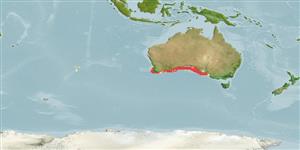
Eastern Indian Ocean: off the south and southwest coasts of Australia.
東印度洋: 澳洲的特有種, 從大的澳洲灣,袋鼠島澳洲西部到南方, 澳洲南部).
大小 / 重量 / 年齡
成熟度: Lm ? range ? - ? cm
Max length : 36.0 cm TL 雄魚/尚未辨別雌雄; (Ref. 9563)
背棘 (總數) : 8; 背的軟條 (總數) : 8; 臀棘: 3; 臀鰭軟條: 5. Diagnosis: Dorsal rays XIII, 8 with third spine longest. Anal rays III, 5 (6 in 2 of 34 specimens). Pectoral rays 19-21 (mode 20), distal margin bilobed. Pored lateral-line scales 30-34 (32). Longitudinal scale series 49-56 (54). Scale rows between base of last dorsal spine and lateral line 5 or 6 (6). Well-developed gill rakers on upper limb 1, lower limb 5 or 6 (6), total 6 or 7 (7); rudimentary gill rakers on upper limb 3-5 (4), lower limb 4-9 (6). The swim bladder is not bilobed in ventral view, but bilobed anteriorly in lateral view (length 23% of SL, width 17% of SL, bilobed portion 23% of total swim bladder length). Dorsal profile of snout not steep, forming angle of about 40-55° to horizontal axis of head and body. Nasal spine simple, directed upward or slightly backward, length of former greater than or equal to (rarely smaller than) anterior nostril diameter. Posterior margin of premaxilla ascending process extending beyond a vertical at middle of posterior nostril when mouth closed. Interorbital ridge indistinct. No scales on midinterorbital space, but scales present on supraorbital bone. Interorbital space deep, about one-tenth of orbit extending above dorsal profile of head. Preocular with a simple spine, its length slightly greater than or equal to that of nasal spine. Supraocular ridge with 2-6 (usually 3) pointed spines, slightly canted laterally; supraocular ridge much closer to orbit than interorbital ridge in dorsal view. Sphenotic with 2-12 minute pointed spines. Postorbital spine flattened and serrated. Occipital pit absent, nape flat, covered with scales entirely. Nuchal and pterotic spines simple (sometimes with 2 or 3 points), distal margins smooth; origin of nuchal spine anterior to that of pterotic spine, base larger than that of latter. Upper posttemporal spine indistinct, flattened and serrated (rarely smooth); lower posttemporal and supracleithral spines simple. Posterior margin of maxilla not reaching a vertical at posterior margin of orbit (usually just reaching posterior margin of pupil). Maxilla with scales extending posteriorly from between anterior and posterior lacrimal spines, but no scales on posterior margin. Underside of mandible smooth with 3 distinct pores on each side. Lacrimal ridge distinct with 1-7 points (sometimes smooth); anterior lacrimal spine with 1-3 points, directed downward; posterior lacrimal spine with 2-6 points, directed ventroposteriorly; length of anterior lacrimal spine 2 times or more in that of posterior lacrimal spine. Suborbital pit flat, front rimmed by a oblique ridge on lacrimal to ventroanterior margin of orbit; scales present on entire suborbital pit; suborbital ridge with 2 pointed spines in line with lacrimal ridge, spines separated at bases, directed backward; 1-3 spines sometimes arising from each suborbital spine; 1 or 2 scales present between ventral margin of orbit and suborbital ridge; suborbital scales not extending onto eye membrane. Preopercle with 4 (sometimes 5 spines, fifth spine arising above or below uppermost pre opercular spine), 3 lower spines simple, lacking a median ridge, uppermost spine with a median ridge and with a spine distally; length of uppermost preopercular spine less than pupil diameter. Upper opercular spine simple, lacking a median ridge; lower opercular spine simple with a median ridge; tip of lower opercular spine not extending beyond opercular margin (Ref. 54394).
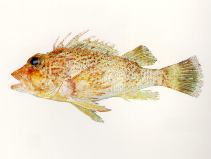
Body tan, white below, with numerous small dark brown to black spots scattered on the upper portion of head and sides; depth 38-40% SL. Head large 43-46%. Eyes large 27-32% HL. Caudal fin rays 13 (Ref. 33839).
Body shape (shape guide): short and / or deep; Cross section: compressed.
身體黃褐色的﹐腹面白色的, 有很多的小深褐色的到黑色的斑點散佈在頭部與側邊的上面部分上; 深度 38-40% SL。 頭部大的 43-46%. 眼大的 27-32% HL。 尾鰭鰭條 13.(參考文獻 33839)
A temperate species found inshore on reefs (Ref. 7300). Captured at depths from 60 - 556 meters, usually less than 250 meters (Ref. 54394).
發現的一個溫帶的種在沿海的礁。 (參考文獻 7300)
生命週期和交配行為
成熟度 | 繁殖 | 產卵場 | 卵 | 孕卵數 | 仔魚
東印度洋: 澳洲的特有種, 從大的澳洲灣,袋鼠島澳洲西部到南方, 澳洲南部).
Motomura, H., 2003. Revision of the scorpionfish genus Neosebastes (Scorpaeniformes: Neosebastidae), with descriptions of five new species. Indo-Pac. Fish. (37):46 p. (Ref. 54394)
IUCN 瀕危狀態 (Ref. 130435: Version 2025-2 (Global))
人類使用
工具
特別的報告
下載 XML
網路資源
基於模型的估計
首選溫度 (參考文獻
123201): 14.7 - 18.2, mean 17 °C (based on 77 cells).
系統發育多樣性指數 (參考文獻
82804): PD
50 = 0.5002 [Uniqueness, from 0.5 = low to 2.0 = high].
Bayesian length-weight: a=0.01995 (0.00906 - 0.04395), b=3.01 (2.83 - 3.19), in cm total length, based on all LWR estimates for this body shape (Ref.
93245).
營養階層 (參考文獻
69278): 3.8 ±0.4 se; based on size and trophs of closest relatives
釣魚的脆弱性 (Ref.
59153): Low to moderate vulnerability (26 of 100).
🛈
營養素 (Ref.
124155): Calcium = 28.1 [11.3, 80.6] mg/100g; Iron = 0.574 [0.265, 1.167] mg/100g; Protein = 18.1 [16.5, 19.7] %; Omega3 = 0.281 [0.118, 0.913] g/100g; Selenium = 28.5 [12.5, 69.5] μg/100g; VitaminA = 33.9 [8.0, 148.9] μg/100g; Zinc = 0.715 [0.455, 1.113] mg/100g (wet weight);