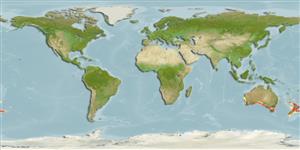
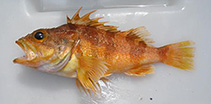
محیط زیست: محیط زیست / منطقه آب و هوایی / تغييرات عمق / محدوده توزیع
بوم شناسي
دريايي نزديك كف زي; تغييرات عمق 50 - 750 m (Ref. 6390). Subtropical; 26°S - 55°S
Southwest Pacific: Australia and New Zealand. Two forms of ocean perch are recognized in waters off New South Wales, Australia (Ref. 6390). They are referred to as 'inshore' and 'offshore' forms based on their preferred depth ranges (Ref. 6390).
A closely related species, Helicolenus barathri, is known from New Zealand and its distribution may also include southern Australian waters (Ref. 30468, 30471).
اندازه / وزن / سن
بلوغ: Lm ? range ? - ? cm
Max length : 47.0 cm TL جنس نر / بدون خواص جنسي; (Ref. 9563); بيشينه وزن گزارش شده: 1.4 kg (Ref. 30476); بيشينه سن گزارش شده: 42 سال ها (Ref. 30476)
خارهاي باله پشتي (کل) : 12; شعاع نرم باله پشتي (کل) : 11 - 12; خارهاي باله مخرجي: 3; شعاع نرم باله مخرجي: 5; مهره ها: 25.
Body shape (shape guide): fusiform / normal.
Occur on the continental shelf and slope (Ref. 9563). Two forms exist in New South Wales, Australia. The inshore form is dominant in depths less than 300 m and the offshore form is most common in deeper waters (Ref. 30468). Juveniles of both forms are caught near the edge of the continental shelf by fishers targeting royal red prawns (Haliporoides sibogae) in Australia, but their full distribution is unknown (Ref. 6390). Reproduction in ocean perch is distinctive in that fertilization is internal (Ref. 6390, 34817). Feed on squid, shrimps and fish (Ref. 6390). Head and dorsal-fin spines are venomous (Ref. 33616). Sold whole and chilled on the domestic fresh fish markets (Ref. 6390).
Larvae stay within the female fish until they are approximately 1 mm long before they are released into the water (Ref. 6390).
In Australia, the inshore and offshore forms of ocean perch begin mating at different times and there is a difference in the length of their larval development prior to release (Ref. 30468).
Kailola, P.J., M.J. Williams, P.C. Stewart, R.E. Reichelt, A. McNee and C. Grieve, 1993. Australian fisheries resources. Bureau of Resource Sciences, Canberra, Australia. 422 p. (Ref. 6390)
وضعيت در فهرست قرمز IUCN (Ref. 130435: Version 2025-2 (Global))
استفاده انسانی
ماهي گيري – شيلات: تجاري
ابزارها
گزارش های ويژه
بارگيری XML
منابع اينترنتي
تخمینها بر اساس مدلها
دمای ترجیحی (مرجع
123201): 10.5 - 16.6, mean 13 °C (based on 72 cells).
شاخص تنوع فیلوژنتیکی (مرجع
82804): PD
50 = 0.5020 [Uniqueness, from 0.5 = low to 2.0 = high].
Bayesian length-weight: a=0.01585 (0.00947 - 0.02651), b=3.12 (2.97 - 3.27), in cm total length, based on LWR estimates for this species & (Sub)family-body (Ref.
93245).
سطح تروفیک (مرجع
69278): 3.9 ±0.6 se; based on diet studies.
جهندگی (مرجع
120179): پايين ، كم, كمينه زمان لازم براي دو برابر شدن جمعيت 5/4 – 14 سال (K=0.11-0.12; tmax=42; Fec=150,000).
آسیبپذیری ماهیگیری (Ref.
59153): High vulnerability (64 of 100).
🛈
مواد مغذی (Ref.
124155): Calcium = 59 [20, 156] mg/100g; Iron = 1.05 [0.46, 2.21] mg/100g; Protein = 17.9 [16.3, 19.7] %; Omega3 = 0.643 [0.281, 1.641] g/100g; Selenium = 42.5 [18.9, 115.9] μg/100g; VitaminA = 24.5 [8.1, 78.9] μg/100g; Zinc = 0.671 [0.378, 1.054] mg/100g (wet weight);