>
Acanthuriformes (Surgeonfishes) >
Ephippidae (Spadefishes, batfishes and scats)
Etymology: Platax: Greek, platys = flat (Ref. 45335).
Eponymy: Major W J A W Boers (d: 1814) was an Infantry officer (later Lieutenant-Colonel) in Gombong, Java. He was later in Leiden, The Netherlands. He was one of many people who supplied Bleeker with specimens from the Dutch East Indies. (Ref. 128868), visit book page.
More on author: Bleeker.
Ambiente: milieu / zona climática / intervalo de profundidade / gama de distribuição
Ecologia
marinhas associadas(os) a recifes; intervalo de profundidade 1 - 50 m (Ref. 9407). Tropical
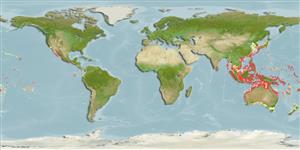
Indo-West Pacific: Indonesia (including Mentawai Islands), New Guinea, and Philippines.
Tamanho / Peso / Idade
Maturidade: Lm ? range ? - ? cm
Max length : 40.0 cm TL macho/indeterminado; (Ref. 9407)
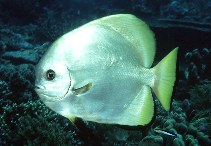
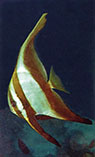
Espinhos dorsais (total) : 5; Raios dorsais moles (total) : 31 - 34; Espinhos anais: 3; Raios anais moles: 24 - 28. Juveniles have extremely elongate vertical fins and closely resemble juvenile P. teira, but tend to be lighter with a silvery hue. Adults have smoothly rounded head profile like P. orbicularis, but usually have golden hue and lack small black spots (Ref. 37816). Adults (above 18 cm) yellowish silvery, usually with small, scattered black spots on body, dark bar through eye, and another bar just behind head. Median fins yellowish green. Anal-fin margin and rear margin of caudal fin black. Pelvic fins black. Small juveniles yellowish brown or silvery, with 2 black bars as in adults. Rear third of body blackish, the black colour continued onto dorsal and anal fins, and the front of the black zone on body often closely precede by a narrow faint dark bar. Caudal fin transparent except for black base. Jaws with bands of slender, flattened, tricuspid teeth, the middle cusp barely longer than lateral cups (Ref 43039).
Body shape (shape guide): short and / or deep.
Adults occur mostly in large schools along drop-offs, including outer reefs; singly in coastal waters. Juveniles are on deep slopes among tall coral formation (Ref. 48637). Benthopelagic (Ref. 58302).
Ciclo de vida e comportamento de acasalamento
Maturidade | Reprodução | Desova | Ovos | Fecundidade | Larvas
Kuiter, R.H. and H. Debelius, 1994. Southeast Asia tropical fish guide. IKAN-Unterwasserarchiv, Frankfurt, Germany. 321 p. (Ref. 9407)
Categoria na Lista Vermelha da IUCN (Ref. 130435: Version 2025-2 (Global))
Ameaça para o homem
Harmless
Utilização humana
Ferramentas
Relatórios especiais
Descarregue XML
Fontes da internet
Estimativas baseadas em modelos
Temperatura preferida (Ref.
123201): 21.3 - 29, mean 28.2 °C (based on 798 cells).
Índice de diversidade filogenética (Ref.
82804): PD
50 = 0.5313 [Uniqueness, from 0.5 = low to 2.0 = high].
Bayesian length-weight: a=0.02818 (0.01180 - 0.06734), b=2.94 (2.74 - 3.14), in cm total length, based on LWR estimates for this (Sub)family-body shape (Ref.
93245).
Nível Trófico (Ref.
69278): 3.5 ±0.3 se; based on size and trophs of closest relatives
Resiliência (Ref.
120179): Médio, tempo mínimo de duplicação da população 1,4 - 4,4 anos (Preliminary K or Fecundity.).
Vulnerabilidade da pesca (Ref.
59153): Low to moderate vulnerability (30 of 100).
🛈
Nutrientes (Ref.
124155): Calcium = 41.7 [20.2, 78.7] mg/100g; Iron = 0.501 [0.278, 0.833] mg/100g; Protein = 19.2 [18.0, 20.3] %; Omega3 = 0.121 [0.073, 0.199] g/100g; Selenium = 31.3 [17.2, 61.8] μg/100g; VitaminA = 63.9 [18.2, 217.7] μg/100g; Zinc = 0.809 [0.542, 1.193] mg/100g (wet weight);