>
Ovalentaria/misc (Various families in series Ovalentaria) >
Pseudochromidae (Dottybacks) > Pseudoplesiopinae
Etymology: Pseudoplesiops: Greek, pseudes = false + Greek, plesios = near (Ref. 45335).
Eponymy: As the common name shows, this is a toponym after the type locality in American Samoa. (Ref. 128868), visit book page.
More on author: Schultz.
Umwelt: Milieu / Klimazone / Tiefenbereich / Verbreitungsgebiet
Ökologie
seewasser riff-verbunden; tiefenbereich 3 - 20 m (Ref. 90102). Tropical; 25°N - 24°S
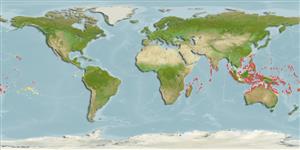
Indo-West Pacific: Maldives to Samoa, north the Yaeyama Islands (Ryukyu Islands), south to northwestern Australia and the southern Great Barrier Reef.
Größe / Gewicht / Alter
Geschlechtsreife: Lm ? range ? - ? cm
Max length : 2.3 cm SL Männchen/unbestimmt; (Ref. 559)
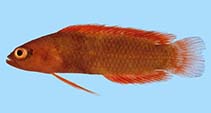
Rückenflossenstacheln (insgesamt) : 1; Rückenflossenweichstrahlen (insgesamt) : 22 - 23; Afterflossenstacheln: 1; Afterflossenweichstrahlen: 13 - 14. Has a red eye and orange head becoming brown on the body (Ref. 37816).
Body shape (shape guide): elongated; Cross section: compressed.
Found in inshore reefs and in caves with rich invertebrate growth in walls (Ref. 48635); feeds on benthic invertebrates (Ref. 1602). Cryptic and seldom seen (Ref 90102).
Lebenszyklus und Paarungsverhalten
Geschlechtsreife | Fortpflanzung | Ablaichen | Eier | Fruchtbarkeit | Larven
Paxton, J.R., D.F. Hoese, G.R. Allen and J.E. Hanley, 1989. Pisces. Petromyzontidae to Carangidae. Zoological Catalogue of Australia, Vol. 7. Australian Government Publishing Service, Canberra, 665 p. (Ref. 7300)
IUCN Rote Liste Status (Ref. 130435: Version 2025-2 (Global))
Bedrohung für Menschen
Harmless
Nutzung durch Menschen
Fischereien: nicht kommerziell
Tools
Zusatzinformationen
Download XML
Internet Quellen
Schätzungen auf der Grundlage von Modellen
Bevorzugte Temperatur (Ref.
123201): 25.5 - 29.3, mean 28.4 °C (based on 2531 cells).
Phylogenetischer Diversitätsindex (Ref.
82804): PD
50 = 0.5005 [Uniqueness, from 0.5 = low to 2.0 = high].
Bayesian length-weight: a=0.00447 (0.00171 - 0.01168), b=3.10 (2.87 - 3.33), in cm total length, based on LWR estimates for this (Sub)family-body shape (Ref.
93245).
Trophische Ebene (Ref.
69278): 3.5 ±0.37 se; based on food items.
Anfälligkeit der Fischerei (Ref.
59153): Low vulnerability (10 of 100).
🛈
Nährstoffe (Ref.
124155): Calcium = 437 [191, 1,139] mg/100g; Iron = 1.61 [0.71, 3.25] mg/100g; Protein = 18.1 [16.7, 19.5] %; Omega3 = 0.118 [0.046, 0.321] g/100g; Selenium = 31.1 [8.6, 94.0] μg/100g; VitaminA = 141 [32, 647] μg/100g; Zinc = 4.3 [2.3, 7.1] mg/100g (wet weight);