Umwelt: Milieu / Klimazone / Tiefenbereich / Verbreitungsgebiet
Ökologie
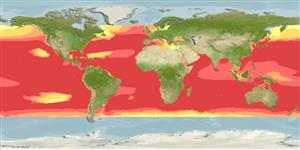
seewasser pelagic-oceanic; ozeanodrom (Ref. 71039); tiefenbereich 0 - 600 m (Ref. 168). Subtropical; 10°C - 25°C (Ref. 168); 60°N - 50°S, 180°W - 180°E
Cosmopolitan in tropical and temperate waters of all oceans including the Mediterranean Sea but not at the surface between 10°N and 10°S. Western Pacific: range extend in a broad band between 40°N and 40°S (Ref. 9684). Often confused with juvenile Thunnus obesus which also have very long pectorals but with rounded tips. Highly migratory species.
Länge bei der ersten Reifung / Größe / Gewicht / Alter
Geschlechtsreife: Lm 85.2, range 83 - ? cm
Max length : 140 cm FL Männchen/unbestimmt; (Ref. 3669); common length : 100.0 cm FL Männchen/unbestimmt; (Ref. 9684); max. veröff. Gewicht: 60.3 kg (Ref. 40637); max. veröff. Alter: 9 Jahre (Ref. 72462)
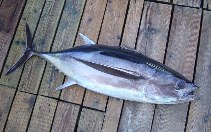
Rückenflossenstacheln (insgesamt) : 11 - 14; Rückenflossenweichstrahlen (insgesamt) : 12 - 16; Afterflossenstacheln: 0; Afterflossenweichstrahlen: 11 - 16. Anterior spines much higher than posterior spines giving the fin a strongly concave outline. Interpelvic process small and bifid. Body with very small scales. Pectoral fins remarkably long, about 30% of fork length or longer in 50 cm or longer fish. Ventral surface of liver striated and the central lobe is largest.
Body shape (shape guide): fusiform / normal; Cross section: oval.
An epipelagic and mesopelagic, oceanic species, abundant in surface waters of 15.6° to 19.4°C; deeper swimming, large albacore are found in waters of 13.5° to 25.2°C; temperatures as low as 9.5°C may be tolerated for short periods (Ref. 168). Known to concentrate along thermal discontinuities (Ref. 168). Form mixed schools with skipjack tuna (Katsuwonus pelamis), yellowfin tuna (Thunnus albacares) and bluefin tuna (T. maccoyii), schools may be associated with floating objects, including sargassum weeds (Ref. 168). Feed on fishes, crustaceans and squids. Eggs and larvae are pelagic (Ref. 6769). Sexual maturity reached at 90 cm (Ref. 36731). Highly appreciated and marketed fresh, smoked, deep frozen or canned. Eaten steamed, broiled, fried and microwaved (Ref. 9987). Also Ref. 1762, 1798, 1804.
Angling: Largely caught offshore, where the waters are mild and blue. Albacore favor those areas where cooler water interfaces with warmer water. They are caught with live of dead baitfish such as mullet, sauries, squid, herring, anchovies, sardines, and other small fish. Albacore strike hard and make powerful runs (Ref. 84357).
The sex ratio in catches is about 1:1 for immature individuals, but males predominate among mature fishes, which is possibly due to both differential mortality of sexes and differential growth rate after maturity.
Collette, B.B. and C.E. Nauen, 1983. FAO Species Catalogue. Vol. 2. Scombrids of the world. An annotated and illustrated catalogue of tunas, mackerels, bonitos and related species known to date. Rome: FAO. FAO Fish. Synop. 125(2):137 p. (Ref. 168)
IUCN Rote Liste Status (Ref. 130435: Version 2025-2 (Global))
Bedrohung für Menschen
Harmless
Nutzung durch Menschen
Fischereien: hoch kommerziell; Sportfisch: ja
Tools
Fatal error: Uncaught mysqli_sql_exception: Too many connections in /var/www/html/includes/speciessummary.lib.php:1888
Stack trace:
#0 /var/www/html/includes/speciessummary.lib.php(1888): mysqli->__construct('mysql', 'fbuser', Object(SensitiveParameterValue), 'fbquizv2', '3306')
#1 /var/www/html/summary/SpeciesSummary.php(1851): checkRecordDisplayFBQuizV2('142', 'PicList')
#2 {main}
thrown in /var/www/html/includes/speciessummary.lib.php on line 1888