Elasmobranchi (squali e razze) (sharks and rays) >
Rhinopristiformes (Shovelnose rays) >
Trygonorrhinidae (Banjo rays, Fiddler rays)
Etymology: Zapteryx: Greek, za = an augmentative particle + Greek, pteryx, wing, fin (Ref. 45335).
More on authors: Müller & Henle.
Ambiente: milieu / zona climatica / distribuzione batimetrica / gamma di distribuzione
Ecologia
marino demersale; distribuzione batimetrica ? - 50 m (Ref. 114953). Subtropical; 20°S - 40°S, 58°W - 47°W (Ref. 114953)
Southwest Atlantic: from northern Argentina to southern Brazil.
Lunghezza alla prima maturità / Dimensione / Peso / Età
Maturità: Lm 46.4 range ? - ? cm
Max length : 53.4 cm TL maschio/sesso non determinato; (Ref. 115173); 59.3 cm TL (female); common length : 50.0 cm TL maschio/sesso non determinato; (Ref. 6077); peso massimo pubblicato: 758.00 g (Ref. ); peso massimo pubblicato: 758.00 g
Breve descrizione
Chiavi di identificazione | Morfologia | Morfometria
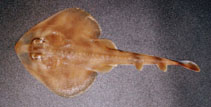
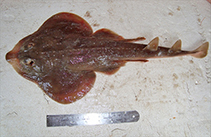
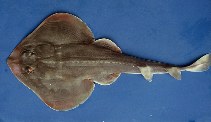
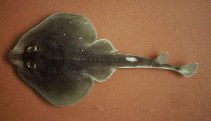
Obtuse snout, broader heart shaped disc. Olive to brownish gray above, without definite markings, dorsal and caudal darker than general ground tint, margins of pectoral and pelvic fins paler. Lower surface grayish or yellowish white, posterior corners of pectoral fins and tips of pelvic fins more or less dusky (Ref. 6902).
Body shape (shape guide): other.
This benthic inshore species is found over soft bottoms to at least 50 m; feeds on benthic crustaceans and polychaetes. Gestation last about a year, produces litters of 1-8 pups in autumn (Ref. 114953). Ovoviviparous (Ref. 50449). Maturity size for males at 43-45 cm TL, females at 42-48 cm TL; birth size at 13-16 cm TL (Ref. 114953).
Exhibit ovoviparity (aplacental viviparity), with embryos feeding initially on yolk, then receiving additional nourishment from the mother by indirect absorption of uterine fluid enriched with mucus, fat or protein through specialised structures (Ref. 50449).
Compagno, L.J.V., 1999. Checklist of living elasmobranchs. p. 471-498. In W.C. Hamlett (ed.) Sharks, skates, and rays: the biology of elasmobranch fishes. Johns Hopkins University Press, Maryland. (Ref. 35766)
Stato della Lista Rossa IUCN (Ref. 130435: Version 2025-2 (Global))
Minaccia per l'uomo
Harmless
Usi umani
Pesca: scarso interesse commerciale
Strumenti
Rapporti speciali
Scarica XML
Fonti Internet
Stime basate su modelli
Indice di diversità filogenetica (Fonte Biblio.
82804): PD
50 = 0.6289 [Uniqueness, from 0.5 = low to 2.0 = high].
Bayesian length-weight: a=0.00617 (0.00308 - 0.01235), b=2.96 (2.77 - 3.15), in cm total length, based on LWR estimates for this species & (Sub)family-body (Ref.
93245).
Livello trofico (Fonte Biblio.
69278): 3.5 ±0.6 se; based on size and trophs of closest relatives
Resilienza (Fonte Biblio.
120179): Basso, tempo minimo di raddoppiamento della popolazione 4.5 - 14 anni (Fec assumed to be <100).
Vulnerabilità della pesca (Ref.
59153): Moderate vulnerability (44 of 100).
🛈
Nutrienti (Ref.
124155): Calcium = 35.9 [5.9, 168.6] mg/100g; Iron = 0.87 [0.23, 2.50] mg/100g; Protein = 19.8 [17.6, 21.7] %; Omega3 = 0.372 [0.152, 0.819] g/100g; Selenium = 15.9 [4.6, 44.3] μg/100g; VitaminA = 12.3 [4.4, 32.7] μg/100g; Zinc = 0.667 [0.317, 1.222] mg/100g (wet weight);