>
Cichliformes (Cichlids, convict blennies) >
Cichlidae (Cichlids) > Pseudocrenilabrinae
Etymology: Sarotherodon: Greek, saros, -ou = sawdust + Greek, ther = animal * Greek, odous = teeth (Ref. 45335).
More on author: Rüppell.
Miljö: miljö / Klimatzon / djupintervall / distributionsområde
Ekologi
marina; sötvatten; brackvatten bottenlevande; pH range: 7.0 - 8.0; dH range: 9 - 19; ej vandrande (Ref. 126106); djupintervall 0 - 3 m (Ref. 5723). Tropical; 27°N - 14°S, 18°W - 31°E
Africa: Lagoons and estuaries from Mauritania to Cameroon. Introduced to several countries in Asia, USA and Europe (Ref. 21). At least one country reports adverse ecological impact after introduction. Previously, three subspecies were recognized: Sarotherodon melanotheron heudelotii, Sarotherodon melanotheron leonensis and Sarotherodon melanotheron melanotheron.
Längd vid första mognad / Storlek / Vikt / Ålder
Könsmognad: Lm 12.1, range 13 - ? cm
Max length : 28.0 cm SL hane/ej könsbestämd; (Ref. 31256); common length : 17.5 cm TL hane/ej könsbestämd; (Ref. 12193)
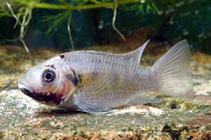
Taggstrålar i ryggfenan (totalt) : 15 - 17; Mjukstrålar i ryggfenan (totalt) : 10 - 12; Taggstrålar i analfenan: 3; Mjukstrålar i analfenan: 8 - 10; Ryggkotor: 26 - 28. Diagnosis: length of caudal peduncle 0.6-0.9 times in its depth (Ref. 53405). Melanic areas in adult usually present on lower parts of head, on cleithrum and on apices of caudal and soft dorsal fins; occasional irregular and asymmetrical spots on flanks probably representing vertical bars; median spot or transverse bar on nape rather constant (Ref. 2).
Body shape (shape guide): short and / or deep.
This species can tolerate high salinity (Ref. 5723). Adults occur abundantly in mangrove areas and ventures in to both fresh, like lower reaches of streams (Ref. 5723) and salt waters in native and non-native ranges (Ref. 46816, 53405). In West Africa, they are confined to brackish lagoons and estuaries, and is abundant in the mangrove zone (Ref. 2). They form schools; is mainly nocturnal with intermittent daytime feeding. They feed on aufwuchs and detritus (Ref. 2), as well as on bivalves and zooplankton (Ref. 28587). Feeding behaviour: picking up and swallowing "bites" (no gill rakers) (Ref. 55661).
Spawns in shallow water close inshore. Initiative in courtship, pit digging and mating activities are taken by the female. Eventually a male is stimulated to react in a mainly passive manner and a pair-bond is established; sexual dimorphism minimal; no T-stand by the partners during fertilization. Exhibits mouth-brooding habit (Ref. 6298). Males exclusively incubate the eggs (Ref. 2, 6309).
Trewavas, E. and G.G. Teugels, 1991. Sarotherodon. p. 425-437. In J. Daget, J.-P. Gosse, G.G. Teugels and D.F.E. Thys van den Audenaerde (eds.) Check-list of the freshwater fishes of Africa (CLOFFA). ISNB, Brussels; MRAC, Tervuren; and ORSTOM, Paris. Vol. 4. (Ref. 4999)
Status på IUCN:s rödlista (Ref. 130435: Version 2025-2 (Global))
Hot mot människor
Potential pest
Mänskliga användningsområden
Fiskeri: kommersiell; Vattenbruk: kommersiell; Akvarium: Kommersiell
Verktyg
Särskilda rapporter
Ladda ner XML
Internet-källor
Uppskattningar baserade på modeller
Index för fylogenetisk mångfald (Ref.
82804): PD
50 = 0.5001 [Uniqueness, from 0.5 = low to 2.0 = high].
Bayesian length-weight: a=0.01778 (0.01381 - 0.02290), b=3.00 (2.93 - 3.07), in cm total length, based on LWR estimates for this species (Ref.
93245).
Trofisk nivå (Ref.
69278): 2.2 ±0.14 se; based on food items.
Generation time: 0.8 (0.5 - 2.8) years. Estimated as median ln(3)/K based on 13
growth studies.
Resiliens (Ref.
120179): Mellan, lägsta populationsfördubblingstid 1,4-4,4 år (K=0.16).
Sårbarhet i fisket (Ref.
59153): Low vulnerability (16 of 100).
🛈
Näringsämnen (Ref.
124155): Calcium = 318 [152, 673] mg/100g; Iron = 1.97 [0.87, 4.12] mg/100g; Protein = 18.4 [16.8, 20.0] %; Omega3 = 0.152 [0.073, 0.347] g/100g; Selenium = 39.5 [19.2, 87.8] μg/100g; VitaminA = 6.27 [1.55, 20.48] μg/100g; Zinc = 1.94 [1.22, 3.12] mg/100g (wet weight);