Umwelt: Milieu / Klimazone / Tiefenbereich / Verbreitungsgebiet
Ökologie
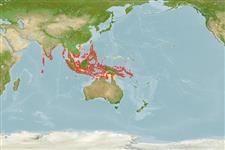
seewasser riff-verbunden; tiefenbereich 3 - 36 m (Ref. 9710). Tropical; 23°N - 14°S, 71°E - 165°E (Ref. 55)
Indo-Pacific: mainly the Indo-Australian Archipelago from the Solomon Islands to Sumatra, and from off Cape York Peninsula, Australia, northward to the Philippines; also occurring in the central and eastern Indian Ocean as far west as Maldives.
Größe / Gewicht / Alter
Geschlechtsreife: Lm ? range ? - ? cm
Max length : 25.0 cm TL Männchen/unbestimmt; (Ref. 48635); common length : 15.0 cm TL Männchen/unbestimmt; (Ref. 55)
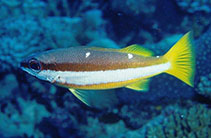
Rückenflossenstacheln (insgesamt) : 11; Rückenflossenweichstrahlen (insgesamt) : 12; Afterflossenstacheln: 3; Afterflossenweichstrahlen: 8. Snout profile low, sloping very gently. Preorbital bone narrow, its width less than half of eye diameter. Preopercular notch and knob poorly developed. Scale rows on back rising obliquely above lateral line. Generally dark brown of the upper part of the head and body with a broad white horizontal band immediately below. The lower part of the head and body dusky brown with a suffusion of yellow. A pair of white spots is on the back just below the dorsal fin base (Ref. 469).
Body shape (shape guide): fusiform / normal; Cross section: oval.
Adults inhabit coral reefs (Ref. 9710, 48635) and outer reef slopes (Ref. 37816, 48635). They sometimes form large schools of more than 100 individuals. Often solitary (Ref. 48635). Feed mainly on small fishes and crustaceans. Generally uncommon (Ref. 9710).
Lebenszyklus und Paarungsverhalten
Geschlechtsreife | Fortpflanzung | Ablaichen | Eier | Fruchtbarkeit | Larven
Allen, G.R., 1985. FAO Species Catalogue. Vol. 6. Snappers of the world. An annotated and illustrated catalogue of lutjanid species known to date. FAO Fish. Synop. 125(6):208 p. Rome: FAO. (Ref. 55)
IUCN Rote Liste Status (Ref. 130435: Version 2025-2 (Global))
Bedrohung für Menschen
Harmless
Nutzung durch Menschen
Fischereien: kommerziell
Tools
Zusatzinformationen
Download XML
Internet Quellen
Schätzungen auf der Grundlage von Modellen
Bevorzugte Temperatur (Ref.
123201): 27.5 - 29.2, mean 28.6 °C (based on 602 cells).
Phylogenetischer Diversitätsindex (Ref.
82804): PD
50 = 0.5000 [Uniqueness, from 0.5 = low to 2.0 = high].
Bayesian length-weight: a=0.01259 (0.00716 - 0.02213), b=2.95 (2.80 - 3.10), in cm total length, based on LWR estimates for this species & Genus-body shape (Ref.
93245).
Trophische Ebene (Ref.
69278): 4.0 ±0.65 se; based on food items.
Widerstandsfähigkeit (Ref.
120179): hoch, Verdopplung der Population dauert weniger als 15 Monate. (Preliminary K or Fecundity.).
Anfälligkeit der Fischerei (Ref.
59153): Low vulnerability (15 of 100).
🛈
Nährstoffe (Ref.
124155): Calcium = 56 [34, 91] mg/100g; Iron = 0.447 [0.286, 0.738] mg/100g; Protein = 18.3 [16.8, 19.7] %; Omega3 = 0.139 [0.091, 0.218] g/100g; Selenium = 46.4 [26.6, 79.4] μg/100g; VitaminA = 283 [54, 1,152] μg/100g; Zinc = 0.498 [0.369, 0.726] mg/100g (wet weight);