>
Eupercaria/misc (Various families in series Eupercaria) >
Lutjanidae (Snappers) > Lutjaninae
Etymology: Lutjanus: Malay, ikan lutjan, name of a fish.
More on author: Castelnau.
Environnement : milieu / zone climatique / profondeur / gamme de distribution
Écologie
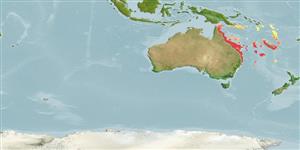
marin récifal; profondeur ? - 20 m (Ref. 9710). Subtropical; 10°S - 37°S, 143°E - 170°E (Ref. 55)
Western Pacific: restricted to the east coast of Australia and New Caledonia. The main Australian distribution is off southern Queensland between Cape Moreton (about 27°S) and the Capricorn Group(23°S). This species has been usually referred to as Lutjanus amabilis by previous authors.
Longueur à la première maturité / Taille / Poids / Âge
Maturité: Lm 25.0, range 20 - 30 cm
Max length : 50.0 cm TL mâle / non sexé; (Ref. 55); common length : 30.0 cm TL mâle / non sexé; (Ref. 55); âge max. reporté: 40 années (Ref. 2290)
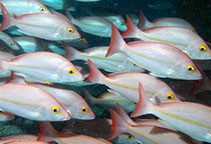
Épines dorsales (Total) : 10; Rayons mous dorsaux (Total) : 14; Épines anales: 3; Rayons mous anaux: 8. Snout somewhat pointed. Preopercular notch and knob moderately well developed. Scale rows on back rising obliquely above lateral line. Generally pale blue-gray to whitish with suffusion of yellow on upper back. A prominent golden brown stripe, slightly narrower than the eye, runs laterally from the rear edge of the of the opercle to the caudal peduncle.
Body shape (shape guide): fusiform / normal; Cross section: oval.
Adults mainly inhabit coral reefs. Sometimes forming large aggregations around rocky outcrops during daylight hours. They disperse to feed at night (Ref. 9710). Usually marketed fresh.
Cycle de vie et comportement reproducteur
Maturité | Reproduction | Frai | Œufs | Fécondité | Larves
Allen, G.R., 1985. FAO Species Catalogue. Vol. 6. Snappers of the world. An annotated and illustrated catalogue of lutjanid species known to date. FAO Fish. Synop. 125(6):208 p. Rome: FAO. (Ref. 55)
Statut dans la liste rouge de l'IUCN (Ref. 130435: Version 2025-2 (Global))
Menace pour l'homme
Harmless
Utilisations par l'homme
Pêcheries: intérêt commercial mineur; pêche sportive: oui
Outils
Articles particuliers
Télécharger en XML
Sources Internet
Estimations basées sur des modèles
Température préférée (Réf.
123201): 23.3 - 27.9, mean 25.9 °C (based on 303 cells).
Indice de diversité phylogénétique (Réf.
82804): PD
50 = 0.5000 [Uniqueness, from 0.5 = low to 2.0 = high].
Bayesian length-weight: a=0.01445 (0.00952 - 0.02194), b=3.02 (2.90 - 3.14), in cm total length, based on LWR estimates for this species & Genus-body shape (Ref.
93245).
Niveau trophique (Réf.
69278): 3.7 ±0.0 se; based on diet studies.
Résilience (Réf.
120179): Très faible, temps minimum de doublement de population supérieur à 14 ans (K=0.13-0.34; tmax=40).
Vulnérabilité de la pêche (Ref.
59153): Moderate vulnerability (38 of 100).
🛈
Nutriments (Ref.
124155): Calcium = 23.7 [11.7, 37.8] mg/100g; Iron = 0.33 [0.19, 0.58] mg/100g; Protein = 19.2 [17.6, 20.6] %; Omega3 = 0.172 [0.101, 0.297] g/100g; Selenium = 22.1 [11.5, 43.5] μg/100g; VitaminA = 87.1 [15.3, 429.9] μg/100g; Zinc = 0.324 [0.228, 0.511] mg/100g (wet weight);