>
Cichliformes (Cichlids, convict blennies) >
Cichlidae (Cichlids) > Pseudocrenilabrinae
Etymology: Sarotherodon: Greek, saros, -ou = sawdust + Greek, ther = animal * Greek, odous = teeth (Ref. 45335).
More on author: Linnaeus.
Ambiente: milieu / zona climatica / distribuzione batimetrica / gamma di distribuzione
Ecologia
; acqua dolce; salmastro demersale; potamodromo (Ref. 51243); distribuzione batimetrica 5 - ? m (Ref. 28714). Subtropical; 22°C - 28°C (Ref. 2059); 35°N - 15°S
Africa and Eurasia: Jordan system, especially in lakes; coastal rivers of Israel; Nile system, including the delta lakes and Lake Albert and Turkana; in West Africa in the Senegal, Gambia, Casamance, Géba, Konkouré, Sassandra, Bandama, Comoé, Niger, Volta, Tano, Lake Bosumtwi, Mono, Ouémé, Ogun, Cross, Benue, Logone, Shari and Lake Chad; Draa (Morocco), Adrar (Mauritania); Saharian oases Borku, Ennedi and Tibesti in northern Chad; Sanaga and Nyong basins in Cameroon (Ref. 4999). In the Congo basin, Sarotherodon galilaeus boulengeri is known from the lower and middle Congo River from Matadi to Pool Malebo (=Stanley Pool) and the lower Kasai (Ref. 2) and Lukenie (Ref. 55074) while Sarotherodon galilaeus galilaeus is present in the middle Congo River basin, in the middle Congo River and drainages of the Ubangi, Uele (Ref. 2, 55074), Itimbiri (Ref. 2, 55074, 106290), Aruwimi (Ref. 106290) and Lomami (Ref. 106245). Sarotherodon galilaeus is also reported from the Luilaka River (Ruki drainage, middle Congo River basin) (Ref. 93897). Five subspecies are recognized: Sarotherodon galilaeus borkuanus, Sarotherodon galilaeus boulengeri, Sarotherodon galilaeus galilaeus, Sarotherodon galilaeus multifasciatus, Sarotherodon galilaeus sanagaensis.
Lunghezza alla prima maturità / Dimensione / Peso / Età
Maturità: Lm 16.3, range 16 - ? cm
Max length : 39.5 cm TL maschio/sesso non determinato; (Ref. 57961); peso massimo pubblicato: 1.6 kg (Ref. 2756)
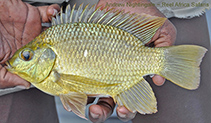
Spine dorsali (totale) : 14 - 17; Raggi dorsali molli (totale) : 11 - 14; Spine anali: 3; Raggi anali molli: 9 - 12; Vertebre: 27 - 31. Diagnosis: 20-27 rakers on lower limb of first arch; length of lower pharyngeal jaw < 43.5% of head length; 29-32 scales in lateral line series; toothed area of lower pharyngeal jaw broad > 2-3 times in keel length (Ref. 81260). Upper profile of snout straight or slightly arched (Ref. 53405). Head length 32.5-39.0% SL (Ref. 53405, 81260). 27-30 total dorsal-fin rays (average 28-29); body depth 43.0-56.5% SL (usually over 45%); length of pectoral fins 36.0-50.0% SL; interorbital space 36.0-44.0% HL (Ref. 53405). Caudal fin naked except at base; melanin patches only in occasional individuals, not populations; reproductive individuals greyish dorsally, silvery ventrally; margin of dorsal and caudal fins pinkish; pectoral usually extending to above vent or spinous anal fin; males with longer soft dorsal and anal fin-rays (Ref. 2).
Body shape (shape guide): short and / or deep; Cross section: compressed.
Has been known to occur at 9°C; occasionally form schools; territorial (Ref. 2). Adults prefer open waters but juveniles and breeding adults are found inshore (Ref. 4999). Often associated with beds of submerged vegetation in Sudd lakes; feed on algae and fine organic debris; bi-parental mouthbrooder (Ref. 28714). Lacks marked sexual dichromatism when sexually active; forms temporary pair bonds (Ref. 81260). Maximum size recorded at 41.0 cm TL (Ref. 2756).
The initiative throughout courting and mating is taken predominantly by the female; female mainly responsible for the excavation of nest and defending mating territory. Pair-formation exists and is dissolved as soon as the eggs are in the parental mouth. Mouth brooding is reportedly biparental.
Trewavas, E., 1983. Tilapiine fishes of the genera Sarotherodon, Oreochromis and Danakilia. British Mus. Nat. Hist., London, UK. 583 p. (Ref. 2)
Stato della Lista Rossa IUCN (Ref. 130435: Version 2025-2 (Global))
Minaccia per l'uomo
Harmless
Usi umani
Pesca: commerciale; Acquacoltura: commerciale; Acquario: Commerciale
Strumenti
Rapporti speciali
Scarica XML
Fonti Internet
Stime basate su modelli
Indice di diversità filogenetica (Fonte Biblio.
82804): PD
50 = 0.5001 [Uniqueness, from 0.5 = low to 2.0 = high].
Bayesian length-weight: a=0.01778 (0.01413 - 0.02238), b=3.01 (2.94 - 3.08), in cm total length, based on LWR estimates for this species (Ref.
93245).
Livello trofico (Fonte Biblio.
69278): 2.0 ±0.00 se; based on food items.
Generation time: 2.1 (1.8 - 2.3) years. Estimated as median ln(3)/K based on 23
growth studies.
Resilienza (Fonte Biblio.
120179): Medio, tempo minimo di raddoppiamento della popolazione 1.4 - 4.4 anni (K=0.22-0.5; tm=1.5-2; Fec > 1,000).
Vulnerabilità della pesca (Ref.
59153): Low to moderate vulnerability (26 of 100).
🛈
Nutrienti (Ref.
124155): Calcium = 107 [46, 211] mg/100g; Iron = 1.28 [0.55, 2.85] mg/100g; Protein = 18.7 [17.1, 20.3] %; Omega3 = 0.262 [0.143, 0.568] g/100g; Selenium = 23.9 [12.2, 50.2] μg/100g; VitaminA = 5.94 [1.45, 21.59] μg/100g; Zinc = 1.06 [0.72, 1.71] mg/100g (wet weight);