>
Eupercaria/misc (Various families in series Eupercaria) >
Labridae (Wrasses) > Julidinae
Etymology: Halichoeres: Greek, als, alis = salt + Greek, choiros = pig (Ref. 45335).
Eponymy: Captain Henry Ezra Nichols (d: 1899) was a US Navy officer at the Department of Alaska. [...] (Ref. 128868), visit book page.
More on authors: Jordan & Gilbert.
Ambiente: milieu / zona climatica / distribuzione batimetrica / gamma di distribuzione
Ecologia
marino associati a barriera corallina; distribuzione batimetrica 3 - 53 m (Ref. 9311), usually 3 - 27 m (Ref. 9311). Tropical; 32°N - 1°S
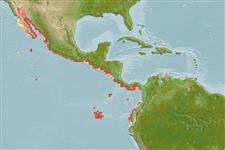
Eastern Pacific: Gulf of California to Panama, including the Galapagos Islands.
Dimensione / Peso / Età
Maturità: Lm ? range ? - ? cm
Max length : 38.0 cm TL maschio/sesso non determinato; (Ref. 9311); common length : 20.0 cm TL maschio/sesso non determinato; (Ref. 55763)
Breve descrizione
Chiavi di identificazione | Morfologia | Morfometria
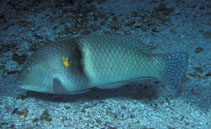
Body moderately slender and compressed; head somewhat small and pointed; teeth caniniform, enlarged, and somewhat crooked, two anterior pairs in each jaw; posterior end of upper jaw with one protruding, forward directed canine on each side; dorsal fin continuous, with 9 spines; lateral line with 28 scales; body blue green, with a dark, vertical bar near posterior edge of pectoral fin, preceded by a very marked yellow spot; all fins except pectorals, blue, speckled with red or light colored spots and stripes (Ref. 55763).
Body shape (shape guide): fusiform / normal.
Found over sand and gravel bottoms near coral reefs. Adults are solitary but juveniles form aggregations, sometimes with other species of wrasses. Feeds on mollusks, brittle stars, sea urchins and crabs. Hides under the sand to sleep and to seek shelter, in cases of danger.
Ciclo vitale e comportamento di accoppiamento
Maturità | Riproduzione | Deposizione | Uova | Fecondità | Larve
Distinct pairing during breeding (Ref. 205).
Gomon, M.F., 1995. Labridae. Viejas, doncellasas, señoritas. p. 1201-1225. In W. Fischer, F. Krupp, W. Schneider, C. Sommer, K.E. Carpenter and V. Niem (eds.) Guia FAO para Identification de Especies para lo Fines de la Pesca. Pacifico Centro-Oriental. 3 Vols. FAO, Rome. (Ref. 9311)
Stato della Lista Rossa IUCN (Ref. 130435: Version 2025-2 (Global))
Minaccia per l'uomo
Harmless
Usi umani
Strumenti
Rapporti speciali
Scarica XML
Fonti Internet
Stime basate su modelli
Temperatura preferita (Fonte Biblio.
123201): 20.6 - 28.5, mean 25.9 °C (based on 62 cells).
Indice di diversità filogenetica (Fonte Biblio.
82804): PD
50 = 0.5000 [Uniqueness, from 0.5 = low to 2.0 = high].
Bayesian length-weight: a=0.01000 (0.00475 - 0.02106), b=3.09 (2.92 - 3.26), in cm total length, based on LWR estimates for this Genus-body shape (Ref.
93245).
Livello trofico (Fonte Biblio.
69278): 4.0 ±0.61 se; based on food items.
Resilienza (Fonte Biblio.
120179): Medio, tempo minimo di raddoppiamento della popolazione 1.4 - 4.4 anni (Preliminary K or Fecundity.).
Vulnerabilità della pesca (Ref.
59153): Low to moderate vulnerability (28 of 100).
🛈
Nutrienti (Ref.
124155): Calcium = 42.7 [26.7, 72.0] mg/100g; Iron = 0.538 [0.319, 0.948] mg/100g; Protein = 18.8 [15.9, 20.9] %; Omega3 = 0.149 [0.101, 0.222] g/100g; Selenium = 30.4 [18.6, 53.0] μg/100g; VitaminA = 111 [34, 399] μg/100g; Zinc = 1.18 [0.83, 1.79] mg/100g (wet weight);