>
Blenniiformes (Blennies) >
Blenniidae (Combtooth blennies) > Blenniinae
Etymology: Meiacanthus: Greek, meion = less = lessen + Greek, akantha = thorn (Ref. 45335).
Umwelt: Milieu / Klimazone / Tiefenbereich / Verbreitungsgebiet
Ökologie
seewasser riff-verbunden. Tropical; 9°S - 24°S
Western Pacific: known only from the Great Barrier Reef.
Größe / Gewicht / Alter
Geschlechtsreife: Lm ? range ? - ? cm
Max length : 9.5 cm TL Männchen/unbestimmt; (Ref. 2334)
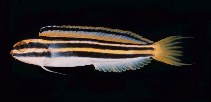
Rückenflossenstacheln (insgesamt) : 4; Rückenflossenweichstrahlen (insgesamt) : 25 - 28; Afterflossenstacheln: 2; Afterflossenweichstrahlen: 15 - 17. Caudal lobes in males elongate; upper 2/3 of head and body yellow with 3 black stripes of equal width to yellow interspaces; head and body below lowermost stripe white; yellow dorsal fin with submarginal black stripe edged in bluish white; yellow caudal fin (Ref. 27362).
Body shape (shape guide): elongated.
Oviparous. Eggs are demersal and adhesive (Ref. 205), and are attached to the substrate via a filamentous, adhesive pad or pedestal (Ref. 94114). Larvae are planktonic, often found in shallow, coastal waters (Ref. 94114). Mimicked by Petroscirtes fallax and by the young Scolopsis bilineatus. Poisonous canines provide considerable protection from predators.
Lebenszyklus und Paarungsverhalten
Geschlechtsreife | Fortpflanzung | Ablaichen | Eier | Fruchtbarkeit | Larven
Oviparous, distinct pairing (Ref. 205).
Randall, J.E., G.R. Allen and R.C. Steene, 1990. Fishes of the Great Barrier Reef and Coral Sea. University of Hawaii Press, Honolulu, Hawaii. 506 p. (Ref. 2334)
IUCN Rote Liste Status (Ref. 130435: Version 2025-2 (Global))
Bedrohung für Menschen
Venomous
Nutzung durch Menschen
Tools
Zusatzinformationen
Download XML
Internet Quellen
Schätzungen auf der Grundlage von Modellen
Phylogenetischer Diversitätsindex (Ref.
82804): PD
50 = 0.5000 [Uniqueness, from 0.5 = low to 2.0 = high].
Bayesian length-weight: a=0.00575 (0.00255 - 0.01297), b=3.06 (2.87 - 3.25), in cm total length, based on LWR estimates for this (Sub)family-body shape (Ref.
93245).
Trophische Ebene (Ref.
69278): 3.4 ±0.4 se; based on size and trophs of closest relatives
Widerstandsfähigkeit (Ref.
120179): hoch, Verdopplung der Population dauert weniger als 15 Monate. (Preliminary K or Fecundity.).
Anfälligkeit der Fischerei (Ref.
59153): Low vulnerability (10 of 100).
🛈
Nährstoffe (Ref.
124155): Calcium = 152 [78, 275] mg/100g; Iron = 0.939 [0.550, 1.653] mg/100g; Protein = 17.9 [16.7, 19.0] %; Omega3 = 0.0924 [, ] g/100g; Selenium = 24 [11, 55] μg/100g; VitaminA = 190 [56, 692] μg/100g; Zinc = 2.12 [1.40, 3.09] mg/100g (wet weight);