Klassifizierung / Names
Namen | Synonyme | Catalog of Fishes(Gattung, Arten) | ITIS | CoL | WoRMS | Cloffa
>
Eupercaria/misc (Various families in series Eupercaria) >
Haemulidae (Grunts) > Haemulinae
Etymology: Rhencus: ρογκοζ (s (snoring); panamensis: Named for its type locality, Panama.
More on author: Steindachner.
Umwelt: Milieu / Klimazone / Tiefenbereich / Verbreitungsgebiet
Ökologie
seewasser demersal; tiefenbereich 10 - 60 m (Ref. 91172). Tropical; 32°N - 10°S, 117°W - 76°W
Eastern Pacific: Gulf of California to Peru.
Größe / Gewicht / Alter
Geschlechtsreife: Lm ? range ? - ? cm
Max length : 39.0 cm TL Männchen/unbestimmt; (Ref. 55763); common length : 25.0 cm TL Männchen/unbestimmt; (Ref. 55763)
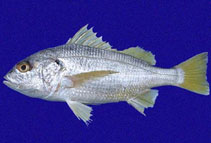
Body oblong, moderately compressed, and not very deep (depth contained 2.3 to 2.5 times in standard length); mouth moderate sized and terminal, its posterior end located at the same level as the anterior rim of the eye; first gill arch with 20 to 23 gill rakers; dorsal fin deeply notched, with 12 to 13 spines and 13 soft rays (XII-XIII, 13); pectoral fins very long (contained 2.7 to 3.3 times in standard length), reaching origin of anal fin; second anal spine much stronger and longer than third; back gray; belly silvery; posterior angle of operculum with a very distinct black spot preceded by a green area (Ref. 55763).
Body shape (shape guide): fusiform / normal.
Adults inhabit sandy bottoms of coastal waters (Ref. 9114). Marketed fresh (Ref. 9114).
Lebenszyklus und Paarungsverhalten
Geschlechtsreife | Fortpflanzung | Ablaichen | Eier | Fruchtbarkeit | Larven
Oviparous, distinct pairing during breeding (Ref. 205).
McKay, R.J. and M. Schneider, 1995. Haemulidae. Burros, corocoros, chulas, gallinazos, roncos. p. 1136-1173. In W. Fischer, F. Krupp, W. Schneider, C. Sommer, K.E. Carpenter and V. Niem (eds.) Guia FAO para Identification de Especies para lo Fines de la Pesca. Pacifico Centro-Oriental. 3 Vols. FAO, Rome. (Ref. 9114)
IUCN Rote Liste Status (Ref. 130435: Version 2025-2 (Global))
Bedrohung für Menschen
Harmless
Nutzung durch Menschen
Fischereien: weniger kommerziell
Tools
Zusatzinformationen
Download XML
Internet Quellen
Schätzungen auf der Grundlage von Modellen
Bevorzugte Temperatur (Ref.
123201): 22.9 - 28.9, mean 26.4 °C (based on 58 cells).
Phylogenetischer Diversitätsindex (Ref.
82804): PD
50 = 0.7500 [Uniqueness, from 0.5 = low to 2.0 = high].
Bayesian length-weight: a=0.01148 (0.00721 - 0.01828), b=2.97 (2.84 - 3.10), in cm total length, based on LWR estimates for this species & (Sub)family-body (Ref.
93245).
Trophische Ebene (Ref.
69278): 3.8 ±0.7 se; based on diet studies.
Widerstandsfähigkeit (Ref.
120179): mittel, Verdopplung der Population dauert 1,4 - 4,4 Jahre. (Preliminary K or Fecundity.).
Anfälligkeit der Fischerei (Ref.
59153): Low to moderate vulnerability (29 of 100).
🛈
Nährstoffe (Ref.
124155): Calcium = 129 [28, 254] mg/100g; Iron = 1.06 [0.54, 2.05] mg/100g; Protein = 18.6 [16.7, 20.4] %; Omega3 = 0.23 [0.12, 0.40] g/100g; Selenium = 49.4 [26.9, 94.2] μg/100g; VitaminA = 23.7 [9.5, 56.2] μg/100g; Zinc = 1.1 [0.8, 1.6] mg/100g (wet weight);