>
Zeiformes (Dories) >
Zeidae (Dories)
Eponymy: Derived from zaeus, an ancient Greek name for this fish dating back to Pliny’s Natural History. [...] There are many alternative names for this fish and almost as many theories as to the origin of the name. [...] (Ref. 128868), visit book page.
More on author: Linnaeus.
Môi trường: môi trường / vùng khí hậu / Mức độ sâu / phạm vi phân phối
Sinh thái học
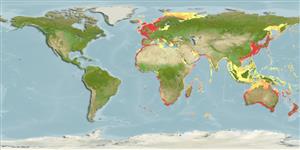
biển; thuộc về nước lợ sống nổi và đáy; Ở đại duơng, biển (Ref. 35388); mức độ sâu 5 - 400 m (Ref. 9563), usually 50 - 150 m (Ref. 4968). Temperate; 75°N - 49°S, 17°W - 177°E (Ref. 54935)
Worldwide in distribution. Eastern Atlantic: Norway to South Africa, also the Mediterranean and Black Sea. Western Pacific: Japan, Korea, Australia and New Zealand. Also known from the Indian Ocean.
Chiều dài lúc trưởng thành đầu tiên / Bộ gần gũi / Khối lượng (Trọng lượng) / Tuổi
Chín muồi sinh dục: Lm 35.1, range 29 - 35 cm
Max length : 90.0 cm TL con đực/không giới tính; (Ref. 6953); common length : 40.0 cm TL con đực/không giới tính; (Ref. 6953); Khối lượng cực đại được công bố: 8.0 kg (Ref. 35388); Tuổi cực đại được báo cáo: 12 các năm (Ref. 5377)
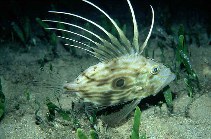
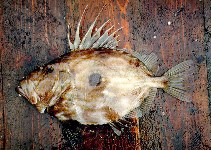
Các tia vây lưng cứng (tổng cộng) : 9 - 11; Các vây lưng mềm (tổng cộng) : 22 - 24; Tia cứng vây hậu môn: 4; Tia mềm vây hậu môn: 20 - 23. Gill rakers rudimentary. Minute scales present. Highly compressed body (Ref. 4253). Large dark spot, surrounded by a light ring on each side of the body (Ref. 35388).
Body shape (shape guide): short and / or deep.
Found in areas close to the sea bed (Ref. 6390). Generally solitary. Feeds mainly on schooling bony fishes, occasionally on cephalopods and crustaceans (Ref. 27121). Reproduction takes place at the end of winter and at the start of spring in the northeastern Atlantic, earlier in the Mediterranean. Eggs are pelagic, maturity reached at 4 years (Ref. 36731). Sold fresh (Ref. 9563) and frozen (Ref. 9988). Can be steamed, fried, broiled, boiled, microwaved and baked (Ref. 9988). The flesh is excellent but is utilized little in West Africa (Ref. 5377).
No studies of their reproductive development or early life history have been undertaken in Australia (Ref. 6390). Pelagic eggs (Ref. 35388).
Karrer, C. and A. Post, 1990. Zeidae. p. 631-633. In J.C. Quero, J.C. Hureau, C. Karrer, A. Post and L. Saldanha (eds.) Check-list of the fishes of the eastern tropical Atlantic (CLOFETA). JNICT, Lisbon; SEI, Paris; and UNESCO, Paris. Vol. 2. (Ref. 6953)
Tình trạng Sách đỏ IUCN (Ref. 130435: Version 2025-2 (Global))
Mối đe dọa đối với con người
Harmless
Sử dụng của con người
Các nghề cá: tính thương mại; cá để chơi: đúng; Bể nuôi cá: Bể cá công cộng
Các công cụ
Báo cáo đặc biệt
Tải xuống XML
Các nguồn internet
Ước tính dựa trên mô hình
Nhiệt độ ưa thích (Tài liệu tham khảo
123201): 6.7 - 23.7, mean 13.6 °C (based on 1223 cells).
Chỉ số đa dạng phát sinh loài (Tài liệu tham khảo
82804): PD
50 = 0.7656 [Uniqueness, from 0.5 = low to 2.0 = high].
Bayesian length-weight: a=0.01585 (0.01311 - 0.01916), b=2.92 (2.86 - 2.98), in cm total length, based on LWR estimates for this species (Ref.
93245).
Mức dinh dưỡng (Tài liệu tham khảo
69278): 4.5 ±0.8 se; based on diet studies.
Thích nghi nhanh (Tài liệu tham khảo
120179): Trung bình, thời gian nhân đôi của chủng quần tối thiểu là 1.4 - 4.4 năm (K=0.15; tm=3-4; tmax=12).
Prior r = 0.74, 95% CL = 0.49 - 1.10, Based on 1 full stock assessment.
Sự dễ bị tổn thương của nghề đánh cá (Ref.
59153): Moderate vulnerability (39 of 100).
🛈
Sự dễ bị tổn thương của khí hậu (Ref.
125649): Moderate vulnerability (38 of 100).
🛈
Chất dinh dưỡng (Ref.
124155): Calcium = 14.1 [8.1, 27.2] mg/100g; Iron = 0.246 [0.139, 0.432] mg/100g; Protein = 19.2 [16.0, 21.6] %; Omega3 = 0.65 [0.34, 1.23] g/100g; Selenium = 21 [10, 42] μg/100g; VitaminA = 16.8 [4.4, 66.5] μg/100g; Zinc = 0.368 [0.254, 0.546] mg/100g (wet weight); based on
nutrient studies.