>
Beloniformes (Needle fishes) >
Exocoetidae (Flyingfishes)
Etymology: Cypselurus: Greek, kypselos, ou = swift + Greek,oura = tail (Ref. 45335).
More on authors: Nichols & Breder.
Environnement : milieu / zone climatique / profondeur / gamme de distribution
Écologie
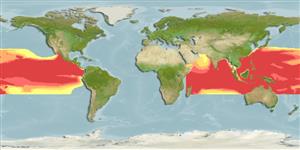
marin pelagic-oceanic; océanodrome (Ref. 51243); profondeur 0 - 20 m (Ref. 27313). Tropical; 34°N - 23°S, 43°E - 79°W
Indo-Pacific: East Africa to Hawaii and the Tuamoto Islands. Probably absent from the inland seas of southeast Asia. Eastern Pacific: isolated population at Soccoro Islands, Mexico, including Revillagigedo Islands.
Taille / Poids / Âge
Maturité: Lm ? range ? - ? cm
Max length : 24.0 cm SL mâle / non sexé; (Ref. 9839)
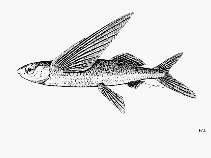
Rayons mous dorsaux (Total) : 13; Rayons mous anaux: 8 - 9. Pectoral fins almost uniformly grayish, varying in tone but neither hyaline nor blackish, with a narrow pale posterior edge broadening at the tip and toward the axil of the fin. Predorsal scales 28-30. Ventral origin equidistant from about or behind the middle of opercle and base of caudal. Head narrow and pointed for this genus, the snout equal to or slightly longer than eye. Teeth tricuspid. Interobital slightly concave; eye slightly infralateral.
Coloration: Dark above to below midline of side, pale below; dorsal very pale grayish; anal white; caudal uniform dusky; ventrals pale becoming slightly dusky in the center of their base.
Body shape (shape guide): elongated.
Epipelagic in coastal and oceanic waters. Often near oceanic islands. May leap out of the water and glide over considerable distances above the surface. Also caught using dipnet and light method (Ref. 9839).
Cycle de vie et comportement reproducteur
Maturité | Reproduction | Frai | Œufs | Fécondité | Larves
Nichols, J.T. and C.M. Breder Jr., 1935. New Pacific flying-fishes collected by Templeton Crocker. Am. Mus. Novit. 821:1-4. (Ref. 98576)
Statut dans la liste rouge de l'IUCN (Ref. 130435: Version 2025-2 (Global))
Menace pour l'homme
Harmless
Utilisations par l'homme
Pêcheries: intérêt commercial mineur
Outils
Articles particuliers
Télécharger en XML
Sources Internet
Estimations basées sur des modèles
Température préférée (Réf.
123201): 24.4 - 29.3, mean 27.7 °C (based on 32228 cells).
Indice de diversité phylogénétique (Réf.
82804): PD
50 = 0.5002 [Uniqueness, from 0.5 = low to 2.0 = high].
Bayesian length-weight: a=0.00646 (0.00293 - 0.01422), b=3.04 (2.85 - 3.23), in cm total length, based on LWR estimates for this (Sub)family-body shape (Ref.
93245).
Niveau trophique (Réf.
69278): 4.0 ±0.6 se; based on size and trophs of closest relatives
Résilience (Réf.
120179): Haut, temps minimum de doublement de population inférieur à 15 mois (Preliminary K or Fecundity.).
Vulnérabilité de la pêche (Ref.
59153): Low vulnerability (19 of 100).
🛈