>
Scombriformes (Mackerels) >
Scombridae (Mackerels, tunas, bonitos) > Scombrinae
Etymology: Scomberomorus: Latin, scomber = mackerel + Greek, moros = silly, stupid (Ref. 45335).
More on authors: Jordan & Starks.
Entorno: milieu / zona climática / rango de profundidad / gama de distribución
Ecología
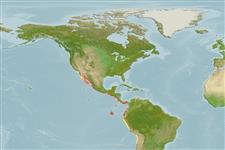
marino pelagic-neritic; oceanodromo (Ref. 51243); rango de profundidad 10 - 60 m (Ref. 91172). Tropical; 33°N - 27°S, 121°W - 70°W (Ref. 168)
Eastern Central Pacific: La Jolla in southern California, USA to the Galapagos Islands and Paita, Peru. Recently reported from Antofagasta, Chile. Many authors have erroneously considered this species to be a synonym of Scomberomorus maculatus, or a subspecies of it.
Longitud en la primera madurez / Tamaño / Peso / Edad
Madurez: Lm 43.9, range 26 - 32 cm
Max length : 99.0 cm FL macho / no sexado; (Ref. 40637); common length : 60.0 cm FL macho / no sexado; (Ref. 168); peso máximo publicado: 8.2 kg (Ref. 4699)
Descripción breve
Claves de identificación | Morfología | Morfometría
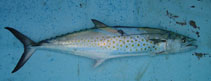
Espinas dorsales (total) : 15 - 18; Radios blandos dorsales (total) : 16 - 19; Radios blandos anales: 16 - 21; Vértebra: 46 - 49. Interpelvic process small and bifid. Body covered with small scales. Lateral line gradually curving down toward caudal peduncle. Intestine with 2 folds and 3 limbs. Swim bladder absent. Pelvic fins relatively long. Sides silvery with numerous round brownish (orange in life) spots, three rows above lateral line, one above. The first dorsal fin is black distally and white at the base. The second dorsal fin is tinged with yellowish and with black margin. The anal fin is white.
Body shape (shape guide): fusiform / normal; Cross section: oval.
A schooling species believed to spawn close to the coast over most of its range. Adults occur near the surface of coastal waters to over bottom of the continental shelf (Ref. 11035). Adults feed on small fishes, particularly anchovies (Anchoa and Cetengraulis) and clupeids (Odontognathus and Opisthonema). The most abundant game fish along the Pacific coasts of Mexico and Central America. An excellent food fish enough to support a commercial fishery. Marketed fresh and frozen; also used for ceviche (Ref. 9987).
Ciclo vital y comportamiento de apareamiento
Madurez | Reproducción | Puesta | Huevos | Fecundidad | Larva
Collette, B.B. and C.E. Nauen, 1983. FAO Species Catalogue. Vol. 2. Scombrids of the world. An annotated and illustrated catalogue of tunas, mackerels, bonitos and related species known to date. Rome: FAO. FAO Fish. Synop. 125(2):137 p. (Ref. 168)
Situación en la Lista Roja de la UICN (Ref. 130435: Version 2025-2 (Global))
Amenaza para el ser humano
Harmless
Usos humanos
Pesquerías: comercial; pesca deportiva: si
Herramientas
Informes especiales
Descargar XML
Fuentes de Internet
Estimaciones basadas en modelos
Temperatura preferida (Referencia
123201): 19.4 - 28.9, mean 25.8 °C (based on 80 cells).
Índice de diversidad filogenética (Referencia
82804): PD
50 = 0.5000 [Uniqueness, from 0.5 = low to 2.0 = high].
Bayesian length-weight: a=0.00617 (0.00404 - 0.00942), b=2.93 (2.81 - 3.05), in cm total length, based on LWR estimates for this species & Genus-body shape (Ref.
93245).
Nivel trófico (Referencia
69278): 4.5 ±0.8 se; based on diet studies.
Resiliencia (Referencia
120179): Medio, población duplicada en un tiempo mínimo de 1.4-4.4 años (Assuming tm=2-4).
Prior r = 0.57, 95% CL = 0.37 - 0.85, Based on 1 data-limited stock assessment.
Vulnerabilidad pesquera (Ref.
59153): Moderate to high vulnerability (51 of 100).
🛈
Vulnerabilidad climática (Ref.
125649): High vulnerability (64 of 100).
🛈
Nutrientes (Ref.
124155): Calcium = 32.7 [14.5, 115.5] mg/100g; Iron = 0.827 [0.363, 2.008] mg/100g; Protein = 20.7 [19.4, 21.9] %; Omega3 = 0.253 [0.153, 0.419] g/100g; Selenium = 54.2 [19.9, 174.5] μg/100g; VitaminA = 23.4 [5.6, 102.0] μg/100g; Zinc = 0.651 [0.429, 1.035] mg/100g (wet weight);