Klassifizierung / Names
Namen | Synonyme | Catalog of Fishes(Gattung, Arten) | ITIS | CoL | WoRMS | Cloffa
>
Synbranchiformes (Spiny eels) >
Mastacembelidae (Spiny eels)
Etymology: Macrognathus: Greek, makros = great + Greek, gnathos = jaw (Ref. 45335).
Eponymy: Dr Albert Karl Ludwig Gotthilf Günther (1830–1914) was a German-born British zoologist, ichthyologist and herpetologist. [...] (Ref. 128868), visit book page.
More on author: Day.
Umwelt: Milieu / Klimazone / Tiefenbereich / Verbreitungsgebiet
Ökologie
; süßwasser benthopelagisch. Tropical
Asia: India.
Größe / Gewicht / Alter
Geschlechtsreife: Lm ? range ? - ? cm
Max length : 29.9 cm SL Männchen/unbestimmt; (Ref. 97143); common length : 20.0 cm TL Männchen/unbestimmt; (Ref. 4833)
Kurzbeschreibung
Bestimmungsschlüssel | Morphologie | Morphometrie
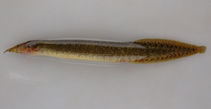
Afterflossenweichstrahlen: 62 - 75. Macrognathus guentheri can be distinguished from Macrognathus albus by the following characters: body with distinct bars or marblings (vs. absent in M. albus), head shorter (14.1-6.3 % SL vs. 16.6- 17.4) and less deep (39.5-42.2 % HL vs.43.0- 48.6), body wider (7.0-7.5 % SL vs. 5.7- 7.1), pre dorsal (21.1-24.0 % SL vs. 26.9-28.4) and pre anal (56.0-61.6 % SL vs. 61.5-67.4) distances shorter, eyes are widely set (inter orbital width 10.5- 12.0 % HL vs. 6.3- 6.8), snout shorter (37.2- 41.1 % HL vs. 42.8- 48.4) and anal fin with 62-75 soft rays (vs. 56-62); irregular blotches absent on the mid dorsal side and extending a little to upper lateral side stretching from the opercle to caudal base (vs. present); dorsal spines comparatively longer and prominent (vs. short and partly hidden under skin); spinous part of dorsal fin originating just behind the end of pectoral fin (vs. originating considerably behind the end of pectoral fin); and preorbital spine present (vs. absent) (Ref. 97143).
Found in pools and running waters.
Lebenszyklus und Paarungsverhalten
Geschlechtsreife | Fortpflanzung | Ablaichen | Eier | Fruchtbarkeit | Larven
Talwar, P.K. and A.G. Jhingran, 1991. Inland fishes of India and adjacent countries. Volume 2. A.A. Balkema, Rotterdam, i-xxii + 543-1158, 1 pl. (Ref. 4833)
IUCN Rote Liste Status (Ref. 130435: Version 2025-2 (Global))
Bedrohung für Menschen
Harmless
Nutzung durch Menschen
Fischereien: weniger kommerziell; Aquarium: Kommerziell
Tools
Zusatzinformationen
Download XML
Internet Quellen
Schätzungen auf der Grundlage von Modellen
Phylogenetischer Diversitätsindex (Ref.
82804): PD
50 = 0.5000 [Uniqueness, from 0.5 = low to 2.0 = high].
Bayesian length-weight: a=0.00295 (0.00136 - 0.00638), b=2.94 (2.77 - 3.11), in cm total length, based on LWR estimates for this Genus-body shape (Ref.
93245).
Trophische Ebene (Ref.
69278): 3.3 ±0.4 se; based on size and trophs of closest relatives
Widerstandsfähigkeit (Ref.
120179): mittel, Verdopplung der Population dauert 1,4 - 4,4 Jahre. (Preliminary K or Fecundity.).
Anfälligkeit der Fischerei (Ref.
59153): Low to moderate vulnerability (26 of 100).
🛈