Περιβάλλον: περιβάλλον / κλιματική ζώνη / εύρος βάθους / εύρος διανομής
Οικολογία
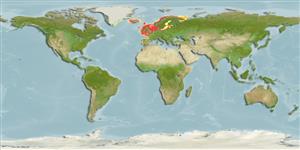
Θαλασσινό(ά); Υφάλμυρο βενθικό(ς); ωκεανόδρομο(ς) (Ref. 51243); εύρος βάθους 0 - 200 m (Ref. 35388), usually 10 - 50 m (Ref. 35388). Temperate; 2°C - 15°C (Ref. 5504); 72°N - 36°N, 47°W - 45°E
Northern Sea. Reports from the Mediterranean Sea appear to be misidentifications of
P. flesus. It may have been present in some areas of the Mediterranean in the past, as a result of climatic changes related to the ice age, but at present times seem to be absent (Ref. 89040).
Μήκος κατά την πρώτη ωρίμανση / Μέγεθος / Βάρος / Ηλικία
Γεννητική Ωρίμανση: Lm 32.7, range 24 - 42 cm
Max length : 100.0 cm SL αρσενικό/απροσδιόριστο; (Ref. 4705); common length : 40.0 cm TL αρσενικό/απροσδιόριστο; (Ref. 3397); μεγ. δημοσιευμένο βάρος: 7.0 kg (Ref. 173); μεγ. αναφερόμενη ηλικία: 50 έτη (Ref. 173)
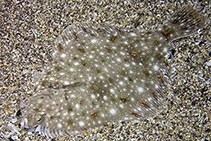
Ραχιαίες άκανθες (συνολικά) : 0; Μαλακές ραχιαίες ακτίνες (συνολικά) : 65 - 79; Εδρικές άκανθες: 0; Μαλακές εδρικές ακτίνες: 48 - 59. Smooth with small scales. Bony ridge behind the eyes. Upper side brown or greenish brown with irregularly distributed bright red or orange spots. The underside is white. Lateral line straight, slightly curved above pectoral fin. Dorsal fin reaching eye. More than 30 vertebrae.
Body shape (shape guide): short and / or deep; Cross section: compressed.
Adults live on mixed bottoms, the older the deeper the occurrence; small individuals are usually seen on bathing beaches (Ref. 9988). Occurs on mud and sand bottom from a few meters down to about 100 m, at sea, estuaries and rarely entering freshwaters (Ref. 59043). Reported as resident intertidal species with homing behavior (Ref. 32612). Feed mainly on thin-shelled mollusks and polychaetes. Batch spawner (Ref. 51846). The most important flatfish for fisheries in Europe. Utilized fresh and frozen; eaten steamed, fried, boiled, microwaved and baked (Ref. 9988). Active at night in the very shallow water while day time is spent buried in the sand. Stationary for long periods, tagging experiments have shown that their spawning migrations can be long. Changes in the environmental conditions have been disadvantageous. Populations in Kattegat and Danish belts decreased in 1980's and early 1990's due to discharge of nutritive salts. Wadden sea is still an excellent nursery ground (Ref.35388).
Adult spawn when the temperature is around 6 °C (Ref. 4705).
Vinnikov, K.A., R.C. Thomson and T.A. Munroe, 2018. Revised classification of the righteye flounders (Teleostei: Pleuronectidae) based on multilocus phylogeny with complete taxon sampling. Molecular phylogenetics and evolution, 125:147-162. (Ref. 122998)
Κατάσταση Κόκκινου Καταλόγου IUCN (Ref. 130435: Version 2025-2 (Global))
Απειλή για τον άνθρωπο
Harmless
Ανθρώπινες χρήσεις
αλιεία: πολύ εμπορικό; Υδατοκαλλιέργειες: Εμπορικό(ά); αλιεία αναψυχής: ναί; Ενυδρείο: Δημόσια ενυδρεία
Εργαλεία
Ειδικές εκθέσεις
Λήψη XML
Διαδικτυακές πηγές
Εκτιμήσεις βάσει μοντέλων
Προτιμώμενη θερμοκρασία (Αναφ.
123201): 6.8 - 12.4, mean 10.2 °C (based on 658 cells).
Δείκτης φυλογενετικής ποικιλότητας (Αναφ.
82804): PD
50 = 0.7500 [Uniqueness, from 0.5 = low to 2.0 = high].
Bayesian length-weight: a=0.00776 (0.00684 - 0.00880), b=3.07 (3.03 - 3.11), in cm total length, based on LWR estimates for this species (Ref.
93245).
Τροφικό Επίπεδο (Αναφ.
69278): 3.2 ±0.3 se; based on diet studies.
Generation time: 9.2 (7.1 - 11.6) years. Estimated as median ln(3)/K based on 17
growth studies.
Ελαστικότητα (Αναφ.
120179): Μεσαίο(α), ελάχιστος χρόνος για διπλασιασμό πληθυσμού 1,4 - 4,4 έτη (K=0.06-0.34; tm=2-6; tmax=30; Fec=50,000).
Prior r = 0.50, 95% CL = 0.33 - 0.75, Based on 28 full stock assessments.
Ευπάθεια στην αλιεία (Ref.
59153): High to very high vulnerability (71 of 100).
🛈
Ευπάθεια στο κλίμα (Ref.
125649): Moderate vulnerability (43 of 100).
🛈
Θρεπτικά συστατικά (Ref.
124155): Calcium = 25.4 [8.2, 51.7] mg/100g; Iron = 0.202 [0.084, 0.542] mg/100g; Protein = 17.3 [15.3, 19.8] %; Omega3 = 0.249 [0.118, 0.544] g/100g; Selenium = 29.6 [10.5, 80.9] μg/100g; VitaminA = 6.73 [1.77, 26.29] μg/100g; Zinc = 0.475 [0.263, 0.968] mg/100g (wet weight); based on
nutrient studies.