Meio ambiente: milieu / Zona climática / intervalo de profundidade / faixa de distribuição
Ecologia
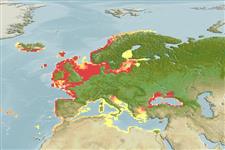
marinhas; Água doce; estuarina demersal; pH range: 7.5 - 8.2; catádromo (Ref. 138126); intervalo de profundidade 1 - 100 m (Ref. 35388). Temperate; 5°C - 25°C (Ref. 13614); 72°N - 30°N, 32°W - 45°E (Ref. 54704)
Eastern Atlantic: coastal and brackish waters of western Europe and from the White Sea to the Mediterranean and the Black Sea (Ref. 4705, Ref. 51442). Introduced into the USA and Canada accidentally through transport in ballast water (Ref. 1739). Asia: Iran (Ref. 39702).
Comprimento de primeira maturação / Tamanho / Peso / Idade
Maturidade: Lm 22.4, range 14 - 30 cm
Max length : 60.0 cm TL macho/indeterminado; (Ref. 35388); common length : 50.0 cm TL macho/indeterminado; (Ref. 30578); peso máx. publicado: 2.9 kg (Ref. 104349); idade máx. registrada: 15 anos (Ref. 3944)
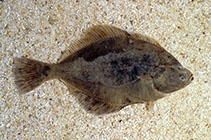
Espinhos dorsais (total) : 0; Raios dorsais (total) : 53 - 62; Espinhos anais: 0; Raios anais : 37 - 46. Flatfish, its disc width less than half its length (Ref. 3137). Small mouth (Ref. 3137, Ref. 51442). Eyes mostly (70%) on right side (Ref. 3137, 51442), 79% of dextrally oriented flounder (n = 1076) in Bos, 2000 (Ref. 57574). Rough skin, especially along the lateral line and the basis of the dorsal and anal fin (Ref. 3137). Lateral line straight, slightly rounded over pectorals (Ref. 3137). Green-olive colored (Ref. 51442), the bottom side white (Ref. 3137). Irregular reddish spots on the eye side (Ref. 35388).
Body shape (shape guide): short and / or deep; Cross section: compressed.
Migratory fish, which is most of the year found in estuaries (Ref. 51442). Adults occur on mud and sand bottom in shallow water, at sea and brackish; often entering freshwaters (Ref. 59043). During winter, adults retreat to deeper, warmer waters, where they spawn in spring (Ref. 30193). The growing larvae are moving to the coast (Ref. 51442). Larvae and early juveniles use selective tidal transport to migrate upstream rivers (Ref. 57575) using a range of triggers such as salinity, prey density and water temperature (Ref. 57573, 57574). Juveniles live in shallow coastal waters and estuaries (Ref. 57574), which are also the summer feeding grounds for the adults (Ref. 30193). Juveniles of less than a year old feed on plankton and larvae of insects, juveniles of more than a year and adults feed on benthic fauna (Ref. 51442), including small fishes and invertebrates (Ref. 30193). Nocturnal and burrowing (Ref. 30193). Marketed fresh and frozen; can be steamed, fried, boiled, microwaved and baked (Ref. 9988). Worms and mollusks are excellent baits for line fishing (Ref. 30578).
Spawns in the water column (Ref. 7471). Produces 400,000 to 2,000,000 eggs for each female (Ref. 51442).
Vinnikov, K.A., R.C. Thomson and T.A. Munroe, 2018. Revised classification of the righteye flounders (Teleostei: Pleuronectidae) based on multilocus phylogeny with complete taxon sampling. Molecular phylogenetics and evolution, 125:147-162. (Ref. 122998)
Status na Lista Vermelha da UICN (Ref. 130435: Version 2025-2 (Global))
Ameaça para os humanos
Harmless
Uso pelos humanos
Pescarias: espécies comerciais; Aquacultura: experimental; peixe esportivo: sim
Ferramentas
Relatórios especiais
Baixar XML
Fontes da internet
Estimativas baseadas em modelos
Temperatura preferida (Ref.
123201): 7.2 - 14.2, mean 10.2 °C (based on 862 cells).
Índice de diversidade filogenética (Ref.
82804): PD
50 = 0.5625 [Uniqueness, from 0.5 = low to 2.0 = high].
Bayesian length-weight: a=0.00759 (0.00671 - 0.00858), b=3.07 (3.03 - 3.11), in cm total length, based on LWR estimates for this species (Ref.
93245).
Nível Trófico (Ref.
69278): 3.3 ±0.2 se; based on diet studies.
Generation time: 4.4 (3.1 - 5.5) years. Estimated as median ln(3)/K based on 13
growth studies.
Resiliência (Ref.
120179): Baixo, tempo mínimo de duplicação da população 4,5 - 14 anos (K=0.22-0.3; tm=2-5; tmax=15; Fec= 2 million).
Prior r = 0.56, 95% CL = 0.37 - 0.83, Based on 5 full stock assessments.
Vulnerabilidade da pesca (Ref.
59153): Moderate to high vulnerability (49 of 100).
🛈
Vulnerabilidade climática (Ref.
125649): Moderate vulnerability (36 of 100).
🛈
Nutrientes (Ref.
124155): Calcium = 33.1 [14.0, 58.0] mg/100g; Iron = 0.26 [0.13, 0.49] mg/100g; Protein = 17.8 [15.6, 19.8] %; Omega3 = 0.322 [0.161, 0.627] g/100g; Selenium = 14.7 [7.4, 32.3] μg/100g; VitaminA = 6.9 [1.9, 26.1] μg/100g; Zinc = 0.509 [0.347, 0.750] mg/100g (wet weight); based on
nutrient studies.