>
Scombriformes (Mackerels) >
Scombridae (Mackerels, tunas, bonitos) > Scombrinae
Etymology: Scomberomorus: Latin, scomber = mackerel + Greek, moros = silly, stupid (Ref. 45335).
More on author: Bloch.
Ambiente: milieu / zona climatica / distribuzione batimetrica / gamma di distribuzione
Ecologia
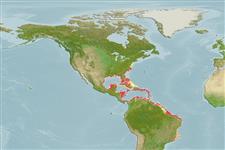
marino associati a barriera corallina; oceanodromo (Ref. 51243); distribuzione batimetrica 1 - 20 m (Ref. 9710), usually 1 - ? m (Ref. 55288). Tropical; 41°N - 24°S, 99°W - 34°W
Western Atlantic: Massachusetts, USA to Brazil, including the Bahamas and West Indies.
Lunghezza alla prima maturità / Dimensione / Peso / Età
Maturità: Lm 40.5, range 38 - ? cm
Max length : 183 cm TL maschio/sesso non determinato; (Ref. 26340); peso massimo pubblicato: 7.8 kg (Ref. 4699)
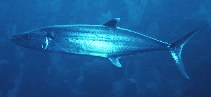
Spine dorsali (totale) : 16 - 18; Raggi dorsali molli (totale) : 15 - 19; Spine anali: 0; Raggi anali molli: 15 - 20; Vertebre: 47 - 48. Interpelvic process small and bifid. Lateral line gently curving down toward caudal peduncle. Intestine with 2 folds and 3 limbs. Swim bladder absent. Body covered with small scales. Anterior third of first dorsal fin black. Pelvic fins relatively long. Sides silvery with one long mid-lateral stripe and with several rows of yellow-orange streaks of variable length and small yellow spots above and below the stripe.
Body shape (shape guide): fusiform / normal; Cross section: oval.
Most abundant in clear waters around coral reefs, occasionally forming schools. Feeds on clupeoids (Harengula, Jenkinsia and Opisthonema) and atherinids (Allanetta [= Craterocephalus), squids and shrimps. Good food and game fish (Ref. 5521). Utilized fresh, smoked and frozen; consumed pan-fried, broiled and baked (Ref. 9987). Sometimes called the "Painted Mackerel" (Ref. 13442).
Collette, B.B. and C.E. Nauen, 1983. FAO Species Catalogue. Vol. 2. Scombrids of the world. An annotated and illustrated catalogue of tunas, mackerels, bonitos and related species known to date. Rome: FAO. FAO Fish. Synop. 125(2):137 p. (Ref. 168)
Stato della Lista Rossa IUCN (Ref. 130435: Version 2025-2 (Global))
Minaccia per l'uomo
Reports of ciguatera poisoning (Ref. 9987)
Usi umani
Pesca: scarso interesse commerciale; Pesce da pesca sportiva: si
Strumenti
Rapporti speciali
Scarica XML
Fonti Internet
Stime basate su modelli
Temperatura preferita (Fonte Biblio.
123201): 23.4 - 28.1, mean 27.3 °C (based on 977 cells).
Indice di diversità filogenetica (Fonte Biblio.
82804): PD
50 = 0.5000 [Uniqueness, from 0.5 = low to 2.0 = high].
Bayesian length-weight: a=0.00977 (0.00517 - 0.01847), b=3.01 (2.85 - 3.17), in cm total length, based on LWR estimates for this species & Genus-body shape (Ref.
93245).
Livello trofico (Fonte Biblio.
69278): 4.5 ±0.4 se; based on diet studies.
Resilienza (Fonte Biblio.
120179): Medio, tempo minimo di raddoppiamento della popolazione 1.4 - 4.4 anni (Fec=160,000; assuming tm=2-4).
Prior r = 0.37, 95% CL = 0.25 - 0.56, Based on 1 data-limited stock assessment.
Vulnerabilità della pesca (Ref.
59153): Very high vulnerability (90 of 100).
🛈
Vulnerabilità climatica (Ref.
125649): High vulnerability (57 of 100).
🛈
Nutrienti (Ref.
124155): Calcium = 8.08 [3.23, 27.36] mg/100g; Iron = 0.327 [0.126, 0.834] mg/100g; Protein = 21.2 [19.7, 22.7] %; Omega3 = 0.113 [0.070, 0.193] g/100g; Selenium = 39.6 [12.7, 130.5] μg/100g; VitaminA = 66.6 [12.9, 341.5] μg/100g; Zinc = 0.541 [0.330, 0.918] mg/100g (wet weight);