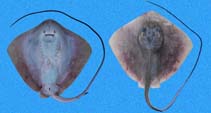
Environnement : milieu / zone climatique / profondeur / gamme de distribution
Écologie
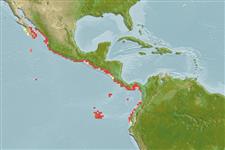
marin récifal. Tropical; 26°N - 3°S, 113°W - 76°W (Ref. 114953)
Eastern Central Pacfic: Baja California (Mexico) to Ecuador; including the Galapagos Is.
Longueur à la première maturité / Taille / Poids / Âge
Maturité: Lm 110.0 range ? - ? cm
Max length : 260 cm TL mâle / non sexé; (Ref. 9254)
Inhabit rocky and coral reefs (Ref. 12951); on soft and sandy bottoms. Feeds mainly on mantis shrimps and fishes (Ref. 114953). Ovoviviparous (Ref. 50449). Litters of 1-5 pups; gestation period 10-11 months (Ref. 114953); Caught rarely by the gillnet fisheries operating in shelf waters. Utilized for its meat (Ref.58048).
Cycle de vie et comportement reproducteur
Maturité | Reproduction | Frai | Œufs | Fécondité | Larves
Exhibit ovoviparity (aplacental viviparity), with embryos feeding initially on yolk, then receiving additional nourishment from the mother by indirect absorption of uterine fluid enriched with mucus, fat or protein through specialised structures (Ref. 50449). Distinct pairing with embrace (Ref. 205). Brood consists of 1-3 neonates and grow to about 40 cm DW in spring-summer (Ref. 38396).
Compagno, L.J.V., 1999. Checklist of living elasmobranchs. p. 471-498. In W.C. Hamlett (ed.) Sharks, skates, and rays: the biology of elasmobranch fishes. Johns Hopkins University Press, Maryland. (Ref. 35766)
Statut dans la liste rouge de l'IUCN (Ref. 130435: Version 2025-2 (Global))
Utilisations par l'homme
Pêcheries: intérêt commercial mineur
Outils
Articles particuliers
Télécharger en XML
Sources Internet
Estimations basées sur des modèles
Température préférée (Réf.
123201): 23.1 - 28.5, mean 27 °C (based on 40 cells).
Indice de diversité phylogénétique (Réf.
82804): PD
50 = 0.5010 [Uniqueness, from 0.5 = low to 2.0 = high].
Bayesian length-weight: a=0.00447 (0.00189 - 0.01058), b=3.12 (2.92 - 3.32), in cm total length, based on LWR estimates for this (Sub)family-body shape (Ref.
93245).
Niveau trophique (Réf.
69278): 3.5 ±0.37 se; based on food items.
Résilience (Réf.
120179): Très faible, temps minimum de doublement de population supérieur à 14 ans (Fec=1-3).
Vulnérabilité de la pêche (Ref.
59153): Very high vulnerability (90 of 100).
🛈
Nutriments (Ref.
124155): Calcium = 4.25 [0.50, 62.97] mg/100g; Iron = 0.352 [0.028, 3.714] mg/100g; Protein = 22.4 [20.0, 24.7] %; Omega3 = 0.0681 [, ] g/100g; Selenium = 41.8 [8.1, 218.8] μg/100g; VitaminA = 14.9 [1.2, 155.3] μg/100g; Zinc = 0.592 [0.036, 6.796] mg/100g (wet weight);