Elasmobranchii (tubarões e raias) (sharks and rays) >
Myliobatiformes (Stingrays) >
Dasyatidae (Stingrays) > Urogymninae
Etymology: Pateobatis: Combination of Latin 'pateo' for 'lie open, be exposed' and 'batis' for skate, ray or flatfish; referring to the eclectic nature of members of this group.
Eponymy: Dr Pieter Bleeker (1819–1878) was an ichthyologist and army surgeon commissioned (1841) by the Dutch East India Company. [...] (Ref. 128868), visit book page.
More on author: Blyth.
Taxonomic Remarks
Former synonym of Pateobatis uarnacoides (both previously under Himantura), but was resurrected as valid species (Ref. 114953).
Ambiente: milieu / zona climática / intervalo de profundidade / gama de distribuição
Ecologia
marinhas; estuarina bentopelágico; anfídromo (Ref. 51243); intervalo de profundidade ? - 30 m (Ref. 9840). Tropical
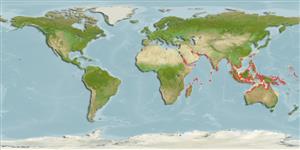
Northern Indian Ocean: Pakistan to Myanmar (but range needs refinement).
Tamanho / Peso / Idade
Maturidade: Lm ? range ? - ? cm
Max length : 84.0 cm WD macho/indeterminado; (Ref. 121648); 112.0 cm WD (female); peso máx. Publicado: 21.1 kg (Ref. 121648); peso máx. Publicado: 21.1 kg
Enters estuaries (Ref. 4832). Found mainly on muddy bottoms to at least 40 m depth. Most likely to feed on small crustaceans (Ref. 114953). Ovoviviparous (Ref. 50449). Feeds on bottom-living invertebrates (Ref. 68964).
Ciclo de vida e comportamento de acasalamento
Maturidade | Reprodução | Desova | Ovos | Fecundidade | Larvas
Exhibit ovoviparity (aplacental viviparity), with embryos feeding initially on yolk, then receiving additional nourishment from the mother by indirect absorption of uterine fluid enriched with mucus, fat or protein through specialised structures (Ref. 50449). Distinct pairing with embrace (Ref. 205).
Talwar, P.K. and A.G. Jhingran, 1991. Inland fishes of India and adjacent countries. vol 1. A.A. Balkema, Rotterdam. i-liv + 1-541, 1 map (Ref. 4832)
Categoria na Lista Vermelha da IUCN (Ref. 130435: Version 2025-2 (Global))
Ameaça para o homem
Venomous
Utilização humana
Pescarias: espécies comerciais
Ferramentas
Relatórios especiais
Descarregue XML
Fontes da internet
Estimativas baseadas em modelos
Temperatura preferida (Ref.
123201): 26.6 - 29.3, mean 28.6 °C (based on 2266 cells).
Índice de diversidade filogenética (Ref.
82804): PD
50 = 0.5312 [Uniqueness, from 0.5 = low to 2.0 = high].
Bayesian length-weight: a=0.01023 (0.00482 - 0.02174), b=3.06 (2.86 - 3.26), in cm total length, based on LWR estimates for this (Sub)family-body shape (Ref.
93245).
Nível Trófico (Ref.
69278): 3.5 ±0.5 se; based on size and trophs of closest relatives
Resiliência (Ref.
120179): Baixo, tempo mínimo de duplicação da população 4,5 - 14 anos (Assuming fecundity<100).
Vulnerabilidade da pesca (Ref.
59153): Very high vulnerability (90 of 100).
🛈