Elasmobranchii (hajar och rockor) (sharks and rays) >
Rhinopristiformes (Shovelnose rays) >
Rhinobatidae (Guitarfishes)
Etymology: Rhinobatos: Greek, rhinos = nose + Greek, batis, -idos = a ray (Raja sp.) (Ref. 45335).
More on author: Norman.
Miljö: miljö / Klimatzon / djupintervall / distributionsområde
Ekologi
marina; brackvatten bottenlevande; amfidrom (Ref. 51243); djupintervall 70 - 76 m (Ref. 123963). Tropical; 24°N - 5°N, 66°E - 91°E (Ref. 114953)
Indian Ocean: West Bengal to Myanmar, upper Bay of Bengal (India) to possibly Arabian Sea; Sri Lanka (Ref. 114953).
Storlek / Vikt / Ålder
Könsmognad: Lm ? range ? - ? cm
Max length : 75.0 cm TL hane/ej könsbestämd; (Ref. 114953)
Kort beskrivning
Bestämningsnycklar | Morfologi | Morfometri
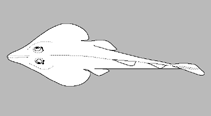
This species is distinguished by the following set of characters: disc is wedge-shaped, rather large, its width 35-37% TL, its length 1.2-1.3 times width; snout is relatively short, length 2.5-2.7 times interspiracular distance, ~3.4 times interorbital width; orbit diameter 1.2-1.4 times the spiracle length; nostrils are moderately oblique, length 1.3-1.5 times internarial distance; mouth width 6.3-6.9% TL; preoral length 5.5-5.9 times internarial distance; posterior nasal flaps are broad; two spiracular folds, the outermost fold subequal to marginally taller than inner fold; ridges of the rostral cartilage almost parallel, widely separated, converging slightly anteriorly but not constricted medially; anterior cartilage weakly sickle-shaped, almost truncate posteriorly; distance between the fifth gill slits 2.5-2.7 times in ventral head length; prebranchial sensory pore system distinct, extending posteriorly to margin of first gill slit; postscapular sensory canal notched, the lateral pores exposed; with weak thorn patches on supraorbit and scapular region, and row of rudimentary thorns (inconspicuous) along dorsal midline; denticles on dorsal fins densest anteriorly, more sparse posteriorly; dorsal fins are small, height of first 7.7-8.1% TL; pelvic-fin inner margin subequal to or shorter than its base length; interdorsal distance 2.3-2.9 times first dorsal-fin base; dorsal caudal margin 1.9-2.0 times the preventral margin; upper jaw with ~118 tooth rows; snout angle ~61°; pectoral radials 68-72; post-synarcual centra ~164; nasal lamellae ~49. Colouration: dorsal fins brownish anteriorly while dusky posteriorly and apically; dorsal disc of adults is uniformly brown to greenish, with or without large, regularly spaced cloudy blotches (faint orange to dusky, more or less symmetrically arranged and of irregular sizes); ventral disc and tail are pale; undersurface of snout without large, black, teardrop marking (Ref. 123963).
Cross section: flattened.
Found on benthic inshore areas on continental shelf to at least 76 m depth (Ref. 123963). Also known to inhabit river mouths. Ovoviviparous (Ref. 50449). Confused with other species in the Indian Ocean, biology unknown (Ref. 114953).
Livscykel och parningsbeteende
Könsmognad | Reproduktion | Lek | Ägg | Fekunditet | Larver
Exhibit ovoviparity (aplacental viviparity), with embryos feeding initially on yolk, then receiving additional nourishment from the mother by indirect absorption of uterine fluid enriched with mucus, fat or protein through specialised structures (Ref. 50449).
Last, P.R., B. Séret and G.J.P. Naylor, 2019. Description of Rhinobatos ranongensis sp. nov.(Rhinopristiformes: Rhinobatidae) from the Andaman Sea and Bay of Bengal with a review of its northern Indian Ocean congeners. Zootaxa 4576(2):257-287. (Ref. 123963)
Status på IUCN:s rödlista (Ref. 130435: Version 2025-2 (Global))
Hot mot människor
Harmless
Mänskliga användningsområden
Fiskeri: mindre kommeriell
Verktyg
Särskilda rapporter
Ladda ner XML
Internet-källor
Uppskattningar baserade på modeller
Index för fylogenetisk mångfald (Ref.
82804): PD
50 = 0.5000 [Uniqueness, from 0.5 = low to 2.0 = high].
Bayesian length-weight: a=0.00295 (0.00150 - 0.00581), b=3.13 (2.96 - 3.30), in cm total length, based on LWR estimates for this (Sub)family-body shape (Ref.
93245).
Trofisk nivå (Ref.
69278): 3.7 ±0.4 se; based on size and trophs of closest relatives
Resiliens (Ref.
120179): Låg, lägsta populationsfördubblingstid 4,5-14 år (Fec assumed to be <100).
Sårbarhet i fisket (Ref.
59153): Moderate to high vulnerability (50 of 100).
🛈