>
Atheriniformes (Silversides) >
Atherinidae (Silversides) > Atherinomorinae
Etymology: Hypoatherina: Greek, hypo = under + Greek, atherina, the Greek name for the eperlane; 1770 (Ref. 45335).
Eponymy: Coenraad Jacob Temminck (1778–1858) was a Dutch zoologist, illustrator and collector. [...] (Ref. 128868), visit book page.
More on author: Bleeker.
Entorno: milieu / zona climática / rango de profundidad / gama de distribución
Ecología
marino asociado a arrecife; rango de profundidad ? - 8 m (Ref. 86942). Tropical
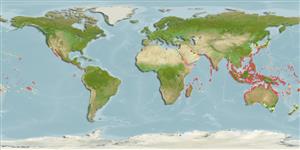
Indo-Pacific: Red Sea and Delagoa Bay, Mozambique (Ref. 4125) and Persian Gulf (Ref. 68964) to the Cook Islands, north to the Caroline Islands, south to Queensland, Australia.
Tamaño / Peso / Edad
Madurez: Lm ? range ? - ? cm
Max length : 12.0 cm TL macho / no sexado; (Ref. 4125)
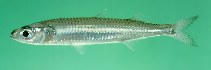
Espinas dorsales (total) : 6 - 8; Radios blandos dorsales (total) : 8 - 10; Espinas anales: 1; Radios blandos anales: 11 - 14. Transparent and blue-green in color, silvery midlateral stripe and abdomen (Ref. 4125). Ascending process of premaxilla moderately long and narrow, lateral process short and wide. Ramus of dentary highly elevated posteriorly. Midlateral band narrow (Ref. 9760). Two rows of pigment spots may be present below lateral band (Ref. 37816).
Body shape (shape guide): elongated; Cross section: oval.
Usually found in coastal waters and harbors within its range. Important as food for larger commercial fishes (Ref. 9760). Used as bait in the tuna fishery (Ref. 6822).
Ciclo vital y comportamiento de apareamiento
Madurez | Reproducción | Puesta | Huevos | Fecundidad | Larva
Oviparous, distinct pairing during breeding (Ref. 205).
Ivantsoff, W., 1984. Atherinidae. In W. Fischer and G. Bianchi (eds.) FAO species identification sheets for fishery purposes. Western Indian Ocean fishing area 51. Vol. 1. (Ref. 3302)
Situación en la Lista Roja de la UICN (Ref. 130435: Version 2025-2 (Global))
Amenaza para el ser humano
Harmless
Usos humanos
Pesquerías: pesquerías de subsistencia; carnada: usually
Herramientas
Informes especiales
Descargar XML
Fuentes de Internet
Estimaciones basadas en modelos
Temperatura preferida (Referencia
123201): 25 - 29.3, mean 28.4 °C (based on 3184 cells).
Índice de diversidad filogenética (Referencia
82804): PD
50 = 0.5001 [Uniqueness, from 0.5 = low to 2.0 = high].
Bayesian length-weight: a=0.00575 (0.00245 - 0.01350), b=3.15 (2.95 - 3.35), in cm total length, based on LWR estimates for this (Sub)family-body shape (Ref.
93245).
Nivel trófico (Referencia
69278): 3.4 ±0.45 se; based on food items.
Resiliencia (Referencia
120179): Alto, población duplicada en un tiempo mínimo inferior a 15 meses (Preliminary K or Fecundity.).
Vulnerabilidad pesquera (Ref.
59153): Low vulnerability (10 of 100).
🛈
Nutrientes (Ref.
124155): Calcium = 114 [61, 210] mg/100g; Iron = 0.793 [0.444, 1.366] mg/100g; Protein = 19.3 [16.9, 21.6] %; Omega3 = 0.124 [0.052, 0.320] g/100g; Selenium = 17.7 [8.6, 44.7] μg/100g; VitaminA = 272 [82, 834] μg/100g; Zinc = 1.73 [1.13, 2.55] mg/100g (wet weight);