>
Acanthuriformes (Surgeonfishes) >
Lobotidae (Tripletails)
Etymology: Hapalogenys: Greek, hapalos = soft * Greek, geny, -yos = face (Ref. 45335).
Eponymy: Kamakichi Kishinouye (1867–1929) was a fisheries biologist at Tokyo Imperial University, where he was a professor in the Faculty of Agriculture. [...] (Ref. 128868), visit book page.
More on authors: Smith & Pope.
Taxonomic Remarks
Family placement uncertain.
Umwelt: Milieu / Klimazone / Tiefenbereich / Verbreitungsgebiet
Ökologie
seewasser benthopelagisch. Tropical
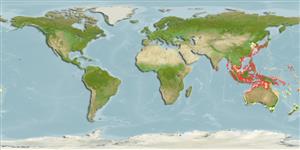
Western Pacific: southern Japan (except Ryukyus) to northwestern Australia (Ref. 36944).
Größe / Gewicht / Alter
Geschlechtsreife: Lm ? range ? - ? cm
Max length : 33.8 cm SL Männchen/unbestimmt; (Ref. 36944)
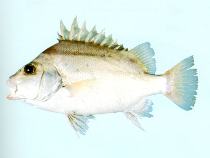
Rückenflossenstacheln (insgesamt) : 11; Rückenflossenweichstrahlen (insgesamt) : 14; Afterflossenstacheln: 3; Afterflossenweichstrahlen: 8 - 9. Body with 4 - 5 longitudinal dark stripes, sometimes with 1 vertical dark band on caudal peduncle. Apparent procumbent spinelike process. No scales on maxilla. Ten chin pores, often slitlike pores posteriorly. Poorly developed papillae and barbels on the fleshy lower lip. No dark margin on dorsal, caudal and anal fins (Ref. 36944).
Body shape (shape guide): short and / or deep.
Inhabits sandy and muddy areas in coastal waters (Ref. 9137, 11230).
Lebenszyklus und Paarungsverhalten
Geschlechtsreife | Fortpflanzung | Ablaichen | Eier | Fruchtbarkeit | Larven
Iwatsuki, Y. and B.C. Russell, 2006. Revision of the genus Hapalogenys (Teleostei: Perciformes) with two new species from the Indo-West Pacific. Mem. Mus. Victoria 63(1):29-46. (Ref. 76777)
IUCN Rote Liste Status (Ref. 130435: Version 2025-2 (Global))
Bedrohung für Menschen
Harmless
Nutzung durch Menschen
Fischereien: kommerziell
Tools
Zusatzinformationen
Download XML
Internet Quellen
Schätzungen auf der Grundlage von Modellen
Bevorzugte Temperatur (Ref.
123201): 20.7 - 28.8, mean 27.5 °C (based on 564 cells).
Phylogenetischer Diversitätsindex (Ref.
82804): PD
50 = 0.5039 [Uniqueness, from 0.5 = low to 2.0 = high].
Bayesian length-weight: a=0.01905 (0.00861 - 0.04217), b=3.01 (2.81 - 3.21), in cm total length, based on LWR estimates for this (Sub)family-body shape (Ref.
93245).
Trophische Ebene (Ref.
69278): 4.0 ±0.65 se; based on food items.
Widerstandsfähigkeit (Ref.
120179): hoch, Verdopplung der Population dauert weniger als 15 Monate. (Preliminary K or Fecundity.).
Anfälligkeit der Fischerei (Ref.
59153): Low to moderate vulnerability (31 of 100).
🛈