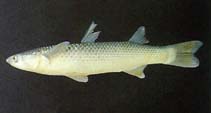
Taxonomic Remarks
In genus Planiliza (Durand et al., 2015: Ref. 114224).
Environnement : milieu / zone climatique / profondeur / gamme de distribution
Écologie
marin; eau douce; saumâtre pelagic-neritic; catadrome (Ref. 46888); profondeur 5 - 10 m (Ref. 559). Temperate; 53°N - 18°N, 105°E - 146°E
Northwest Pacific: Hokkaido southward to Kyushu, Japan; Amur River southward to Xiamen through the Korean Peninsula (Ref. 41299). Reported from Vietnam (Ref. 9706). Introduced in the Aegean Sea (Ref. 113897), Black Sea and the Mediterranean (Ref. 101091).
Longueur à la première maturité / Taille / Poids / Âge
Maturité: Lm ?, range 48 - ? cm
Max length : 80.0 cm TL mâle / non sexé; (Ref. 56557); common length : 50.0 cm TL mâle / non sexé; (Ref. 9137); poids max. publié: 5.0 kg (Ref. 56557)
Description synthétique
Clés d'identification | Morphologie | Morphométrie
Adults inhabit shallow coastal waters as well as freshwater regions of rivers (Ref. 41299). Very common in the rivers discharging into Peter the Great Bay; enter freshwater. Juveniles spend their first year in freshwater then migrate to sea to breed (Ref. 59043). Large concentrations of fry-of-the-year measuring 3.1-6.2 cm in the mouths of rivers in August. Length in the Black Sea is usually 20-30 cm but may reach 43 cm; length in the Atlantic Ocean may reach 50 cm (Ref. 2058). Omnivorous (Ref. 9137). Oviparous, eggs are pelagic and non-adhesive (Ref. 205). Alien Invasive: In Azov Sea, it is now the most abundant mugilid species. Along shores of Black Sea, its expansion corresponds to a sharp decline of native species of Mugilidae, which it apparently replaces (Ref. 59043).
Juveniles spend their first year in freshwater then migrate to sea to breed (Ref. 59043). Also Ref. 205.
Masuda, H. and G.R. Allen, 1993. Meeresfische der Welt - Groß-Indopazifische Region. Tetra Verlag, Herrenteich, Melle. 528 p. (Ref. 9137)
Statut dans la liste rouge de l'IUCN (Ref. 130435: Version 2025-2 (Global))
Menace pour l'homme
Harmless
Utilisations par l'homme
Pêcheries: commercial
Outils
Articles particuliers
Télécharger en XML
Sources Internet
Estimations basées sur des modèles
Température préférée (Réf.
123201): 20.2 - 25, mean 22.4 °C (based on 103 cells).
Indice de diversité phylogénétique (Réf.
82804): PD
50 = 0.5001 [Uniqueness, from 0.5 = low to 2.0 = high].
Bayesian length-weight: a=0.00933 (0.00618 - 0.01409), b=2.95 (2.83 - 3.07), in cm total length, based on LWR estimates for this species & Genus-body shape (Ref.
93245).
Niveau trophique (Réf.
69278): 2.5 ±0.19 se; based on food items.
Generation time: 8.1 ( na - na) years. Estimated as median ln(3)/K based on 2
growth studies.
Résilience (Réf.
120179): Faible, temps minimum de doublement de population : 4,5 à 14 années (0.13-0.23; tm=2-5;).
Vulnérabilité de la pêche (Ref.
59153): High vulnerability (58 of 100).
🛈
Nutriments (Ref.
124155): Calcium = 34.5 [13.5, 102.8] mg/100g; Iron = 0.427 [0.194, 0.861] mg/100g; Protein = 18.9 [17.2, 20.5] %; Omega3 = 0.703 [0.309, 1.611] g/100g; Selenium = 8.06 [3.41, 19.24] μg/100g; VitaminA = 10.2 [2.5, 43.4] μg/100g; Zinc = 0.846 [0.550, 1.305] mg/100g (wet weight);