>
Kurtiformes (Nurseryfishes, cardinalfishes.) >
Apogonidae (Cardinalfishes) > Apogoninae
Etymology: Apogon: Greek, a = without + Greek pogon = chin, beard (Ref. 45335).
More on author: Snyder.
Ambiente: milieu / zona climatica / distribuzione batimetrica / gamma di distribuzione
Ecologia
marino associati a barriera corallina; distribuzione batimetrica 1 - 48 m (Ref. 58302). Tropical
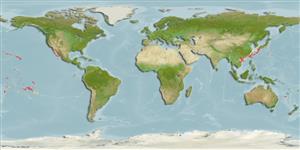
Eastern Central Pacific: known only from the Hawaiian Islands and Johnston Island. Reports of occurrence in other Indo-West Pacific countries are questionable.
Dimensione / Peso / Età
Maturità: Lm ? range ? - ? cm
Max length : 4.0 cm SL maschio/sesso non determinato; (Ref. 40822)
Breve descrizione
Chiavi di identificazione | Morfologia | Morfometria
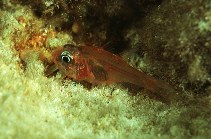
Spine dorsali (totale) : 7; Raggi dorsali molli (totale) : 8 - 9; Spine anali: 2; Raggi anali molli: 8. Differs from other members of the A. erythrinus complex by having the following characteristics: from all others by having a much longer second dorsal fin spine, reaching to at least the base of third ray of second dorsal fin when depressed (spine in other species do not reach third ray); from A. indicus by having 14 pectoral fin rays (versus 13, rarely 12 or 14), and by lacking pigment on the dorsal surface of the caudal peduncle (present in A. indicus); from A. marquesensis by lacking scattered chromatophores on sides of caudal peduncle that extend anteriorly as a band from caudal fin base to vertical from ends of dorsal and anal fin rays (pigment extends forward as a band in A. marquesensis); from A. susanae by having pigment present on scale edges at front of second dorsal fin and sometimes along its base and scattered chromatophores on caudal fin base (absent in A. susanae) (Ref. 40822).
Body shape (shape guide): short and / or deep; Cross section: compressed.
Found in shallow water and observed to be active only at night, near the bottom, and never far from its shelter (Ref. 27665). Benthopelagic (Ref. 58302).
Ciclo vitale e comportamento di accoppiamento
Maturità | Riproduzione | Deposizione | Uova | Fecondità | Larve
Mouthbrooders (Ref. 240). Distinct pairing during courtship and spawning (Ref. 205).
Greenfield, D.W., 2001. Revision of the Apogon erythrinus complex (Teleostei: Apogonidae). Copeia 2001(2):459-472. (Ref. 40822)
Stato della Lista Rossa IUCN (Ref. 130435: Version 2025-2 (Global))
Minaccia per l'uomo
Harmless
Usi umani
Strumenti
Rapporti speciali
Scarica XML
Fonti Internet
Stime basate su modelli
Temperatura preferita (Fonte Biblio.
123201): 23.8 - 28.2, mean 25.9 °C (based on 48 cells).
Indice di diversità filogenetica (Fonte Biblio.
82804): PD
50 = 0.5000 [Uniqueness, from 0.5 = low to 2.0 = high].
Bayesian length-weight: a=0.01514 (0.00700 - 0.03275), b=3.07 (2.89 - 3.25), in cm total length, based on LWR estimates for this (Sub)family-body shape (Ref.
93245).
Livello trofico (Fonte Biblio.
69278): 3.8 ±0.59 se; based on food items.
Resilienza (Fonte Biblio.
120179): Alto, tempo minimo di raddoppiamento della popolazione meno di 15 mesi (tmax=0.3 (120 days)).
Vulnerabilità della pesca (Ref.
59153): Low vulnerability (10 of 100).
🛈
Nutrienti (Ref.
124155): Calcium = 952 [94, 19,045] mg/100g; Iron = 9.11 [1.05, 60.08] mg/100g; Protein = 18.2 [14.3, 21.9] %; Omega3 = 0.107 [0.003, 3.480] g/100g; Selenium = 460 [12, 14,566] μg/100g; VitaminA = 1.94 [0.02, 180.42] μg/100g; Zinc = 14.7 [2.5, 60.1] mg/100g (wet weight);