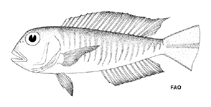
>
Eupercaria/misc (Various families in series Eupercaria) >
Latilidae (Deepwater tilefishes)
Etymology: Branchiostegus: Greek, brangchia = gills + Greek, stego = roof, to cover (Ref. 45335).
Eponymy: Thomas Gloerfelt-Tarp (d: 1949) is a Danish independent consultant fisheries expert currently based in Australia. [...] (Ref. 128868), visit book page.
Umwelt: Milieu / Klimazone / Tiefenbereich / Verbreitungsgebiet
Ökologie
seewasser benthopelagisch; tiefenbereich 50 - 70 m (Ref. 9069). Tropical
Indo-West Pacific: known only from the holotype. From southwest Sumatra to Bali Strait, Indonesia. Probably more widely distributed in the eastern Indian Ocean.
Größe / Gewicht / Alter
Geschlechtsreife: Lm ? range ? - ? cm
Max length : 24.0 cm SL Männchen/unbestimmt; (Ref. 9069)
Lebenszyklus und Paarungsverhalten
Geschlechtsreife | Fortpflanzung | Ablaichen | Eier | Fruchtbarkeit | Larven
Dooley, J.K. and P.J. Kailola, 1988. Four new tilefishes from the northeastern Indian Ocean, with a review of the genus Branchiostegus. Jap. J. Ichthyol. 35(3):247-260. (Ref. 9069)
IUCN Rote Liste Status (Ref. 130435: Version 2025-2 (Global))
Bedrohung für Menschen
Harmless
Nutzung durch Menschen
Fischereien: nicht kommerziell
Tools
Zusatzinformationen
Download XML
Internet Quellen
Schätzungen auf der Grundlage von Modellen
Phylogenetischer Diversitätsindex (Ref.
82804): PD
50 = 0.5000 [Uniqueness, from 0.5 = low to 2.0 = high].
Bayesian length-weight: a=0.00832 (0.00400 - 0.01728), b=3.11 (2.93 - 3.29), in cm total length, based on LWR estimates for this (Sub)family-body shape (Ref.
93245).
Trophische Ebene (Ref.
69278): 3.5 ±0.5 se; based on size and trophs of closest relatives
Widerstandsfähigkeit (Ref.
120179): mittel, Verdopplung der Population dauert 1,4 - 4,4 Jahre. (Preliminary K or Fecundity.).
Anfälligkeit der Fischerei (Ref.
59153): Low vulnerability (19 of 100).
🛈