>
Eupercaria/misc (Various families in series Eupercaria) >
Labridae (Wrasses) > Hypsigenyinae
Etymology: Choerodon: Greek, choiros = a pig + odous = teeth (Ref. 45335); referrring to the prominent anterior canines of the species in this genus (Ref. 116605).
More on author: Richardson.
Umwelt: Milieu / Klimazone / Tiefenbereich / Verbreitungsgebiet
Ökologie
seewasser riff-verbunden. Subtropical
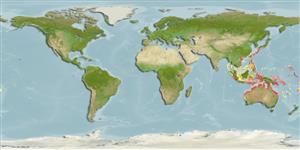
Indo-West Pacific: Western Australia to Queensland. Reported to range from Sri Lanka to Papua New Guinea, north to the Ryukyu Islands, south to New Caledonia (Ref. 9710).
Größe / Gewicht / Alter
Geschlechtsreife: Lm ? range ? - ? cm
Max length : 70.0 cm TL Männchen/unbestimmt; (Ref. 2334)
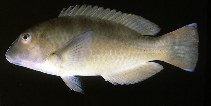
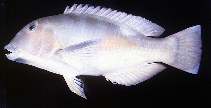
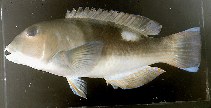
Rückenflossenstacheln (insgesamt) : 13; Rückenflossenweichstrahlen (insgesamt) : 7; Afterflossenstacheln: 3; Afterflossenweichstrahlen: 10. Body with about 5 very faint broad dusky bands dorsally on side in most freshly preserved specimens. A large pale spot often present below posterior end of caudal fin in adults. No darky spot present on side below fifth or sixth dorsal-fin spine. Adults with second prominent anterior canine approximately same size as first, second canine slanted dorsally. (Ref 9823)
Body shape (shape guide): fusiform / normal; Cross section: oval.
Adults inhabit sand and rubble areas of reef flats and flat shelf bottoms of outer reef slopes (Ref. 9710). They enter very shallow water, and feed mainly on mollusks. Oviparous, distinct pairing during breeding (Ref. 205).
Lebenszyklus und Paarungsverhalten
Geschlechtsreife | Fortpflanzung | Ablaichen | Eier | Fruchtbarkeit | Larven
Oviparous, distinct pairing during breeding (Ref. 205).
Randall, J.E., G.R. Allen and R.C. Steene, 1990. Fishes of the Great Barrier Reef and Coral Sea. University of Hawaii Press, Honolulu, Hawaii. 506 p. (Ref. 2334)
IUCN Rote Liste Status (Ref. 130435: Version 2025-2 (Global))
Bedrohung für Menschen
Harmless
Nutzung durch Menschen
Fischereien: kommerziell; Aquarium: Kommerziell
Tools
Zusatzinformationen
Download XML
Internet Quellen
Schätzungen auf der Grundlage von Modellen
Bevorzugte Temperatur (Ref.
123201): 24.6 - 29.3, mean 28.4 °C (based on 1845 cells).
Phylogenetischer Diversitätsindex (Ref.
82804): PD
50 = 0.5000 [Uniqueness, from 0.5 = low to 2.0 = high].
Bayesian length-weight: a=0.00955 (0.00426 - 0.02142), b=3.10 (2.91 - 3.29), in cm total length, based on LWR estimates for this (Sub)family-body shape (Ref.
93245).
Trophische Ebene (Ref.
69278): 3.6 ±0.50 se; based on food items.
Widerstandsfähigkeit (Ref.
120179): niedrig, Verdopplung der Population dauert 4,5 - 14 Jahre. (Preliminary K or Fecundity.).
Anfälligkeit der Fischerei (Ref.
59153): Moderate to high vulnerability (48 of 100).
🛈
Nährstoffe (Ref.
124155): Calcium = 19.6 [9.5, 38.6] mg/100g; Iron = 0.484 [0.269, 0.903] mg/100g; Protein = 19.4 [16.5, 21.6] %; Omega3 = 0.19 [0.11, 0.33] g/100g; Selenium = 17.3 [8.7, 33.0] μg/100g; VitaminA = 47.5 [14.6, 188.4] μg/100g; Zinc = 0.759 [0.516, 1.245] mg/100g (wet weight);