分類 / 名稱
俗名 | 同種異名 | Catalog of Fishes(屬, 種) | ITIS | CoL | WoRMS | Cloffa
Teleostei >
Scombriformes (Mackerels)
鱸形目 (Mackerels) >
Trichiuridae (Cutlassfishes)
帶魚科 (Cutlassfishes) > Trichiurinae
Etymology: Trichiurus: Greek, thrix = hair + Greek, oura = tail (Ref. 45335); lepturus: Specific name from Greek 'lepturus', for its thin or slender tail.
More on author: Linnaeus.
環境: 環境 / 氣候帶 / 深度上下限 / 配送範圍
生態學
海洋; 半鹹淡水 底中水層性; 非產卵性溯降河的 (Ref. 51243); 深度上下限 0 - 589 m (Ref. 58018), usually 100 - 350 m (Ref. 35388). 亞熱帶的; 49°N - 54°S, 114°W - 180°E (Ref. 54931)
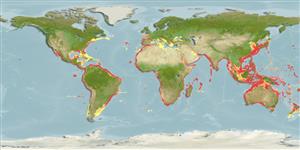
Circumtropical and Circumtemperate: including Gulf of Mexico, Caribbean Sea, Mediterranean Sea, Sea of Marmara, Red Sea, Persian Gulf.
在熱帶與世界的溫帶水域各處。 在日本描述為本來的 白帶魚〔Trichiurus lepturus〕 japonicus 的 日本帶魚〔Trichiurus japonicus〕 與 白帶魚〔Trichiurus lepturus〕 同種異名。 另一個分類的魚種與 白帶魚〔Trichiurus lepturus〕 同種異名是來自東太平洋海洋 (加州到祕魯) 的 太平洋帶魚〔Trichiurus nitens〕 。
初熟時的長度 / 大小 / 重量 / 年齡
成熟度: Lm 50.6, range 30 - 99 cm
Max length : 234 cm TL 雄魚/尚未辨別雌雄; (Ref. 26340); common length : 100.0 cm TL 雄魚/尚未辨別雌雄; (Ref. 26999); 最大體重: 5.0 kg (Ref. )
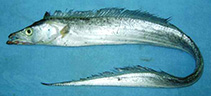
背棘 (總數) : 3; 背的軟條 (總數) : 130 - 135; 臀鰭軟條: 100 - 105. Body extremely elongate, compressed and tapering to a point. Mouth large with a dermal process at the tip of each jaw. Dorsal fin relatively high; anal fin reduced to minute spinules usually embedded in the skin or slightly breaking through; anterior margin of pectoral fin spine not serrated. Pelvic and caudal fins absent. Lateral line beginning at the upper margin of the gill cover, running oblique to behind the tip of the pectoral fins, then straight close to the ventral contour. Fresh specimens steely blue with silvery reflections, becoming uniformly silvery gray sometime after death (Ref. 6181).
Body shape (shape guide): eel-like; Cross section: compressed.
身體非常細長, 扁長形的而且漸漸變細成一個尖點。 在每個頜的頂端嘴巴大的,有一個表皮的突起。 背鰭相當高的; 臀鰭縮小成通常被插入皮膚或些微地突破的細小的小刺了; 胸鰭棘的前緣不鋸齒狀的。 腹鰭與尾鰭不存在。 側線開始在鰓蓋的上緣, 斜向延伸到胸鰭的頂端後面, 然後筆直地接近腹的輪廓。 新鮮的標本鐵藍色的有銀色的反光, 在死亡之後某一個時間變成均勻銀灰色.(參考文獻 6181)
Generally over muddy bottoms of shallow coastal waters (Ref. 9351). Often enter estuaries (Ref. 9351). Juveniles feed mostly on euphausiids, small pelagic planktonic crustaceans and small fishes; adults feed mainly on fishes and occasionally on squids and crustaceans (Ref. 6181). Adults and juveniles have opposing complementary vertical diurnal feeding migration. Large adults usually feed near the surface during the daytime and migrate to the bottom at night. Juveniles and small adults form schools 100 m above the bottom during the daytime and form loose feeding aggregations at night near the surface. Pelagic eggs (Ref. 35388) and larvae (Ref. 6768). Max weight of 1.5 kg given in Ref. 28023 seems too low. The current angling world record was caught in Rio de Janeiro's Guanabara Bay and weighed 3.69 kg. Commercial fisherman have caught fish of up to 5 kg (Capt. Eduardo Baumeier, pers. Comm., 2001). Marketed salted or dried and also frozen (Ref. 9351). Excellent taste when fried or grilled; also for sashimi when fresh.
通常沿岸淺水區在泥沙底上面。 (參考文獻 9351) 時常進入河口。 (參考文獻 9351) 稚魚大部分吃磷蝦,小型大洋性魚類浮游生物甲殼動物與小魚; 成魚主要捕食魚與偶然地吃烏賊與甲殼動物.(參考文獻 6181) 成魚與稚魚有相對垂直日行性覓食迴游。 大的成魚通常在白天的時候吃接近水表面而且迴游到底部在晚上。 稚魚與小的成魚在白天的時候形成魚群 100 公尺上方底部而且形成鬆散的攝食群集在晚上接近水表面。 在市場上銷售鹽醃或乾燥而冷凍的.(參考文獻 9351) 優良的品嚐何時油炸或燒烤; 也新鮮時用作生魚片。 大洋性的卵.(參考文獻 35388) 最大體重為 1.5 公斤記錄在參考文獻 28023 似乎太低。 現在的垂釣世界記錄於里約熱內盧的 Guanabara 海灣與重量為 3.69個公斤捕獲商業的漁夫已經捕捉向上到的魚 5 公斤 (Capt. Eduardo Baumeier , pers. comm。,2001)。
在熱帶與世界的溫帶水域各處。 在日本描述為本來的 白帶魚〔Trichiurus lepturus〕 japonicus 的 日本帶魚〔Trichiurus japonicus〕 與 白帶魚〔Trichiurus lepturus〕 同種異名。 另一個分類的魚種與 白帶魚〔Trichiurus lepturus〕 同種異名是來自東太平洋海洋 (加州到祕魯) 的 太平洋帶魚〔Trichiurus nitens〕 。
Nakamura, I. and N.V. Parin, 1993. FAO Species Catalogue. Vol. 15. Snake mackerels and cutlassfishes of the world (families Gempylidae and Trichiuridae). An annotated and illustrated catalogue of the snake mackerels, snoeks, escolars, gemfishes, sackfishes, domine, oilfish, cutlassfishes,. scabbardfishes, hairtails, and frostfishes known to date. FAO Fish. Synop. 125(15):136 p. (Ref. 6181)
IUCN 瀕危狀態 (Ref. 130435: Version 2025-2 (Global))
無危 (LC) ; Date assessed: 29 January 2013
人類使用
漁業: 高經濟性; 游釣魚種: 是的
工具
特別的報告
下載 XML
網路資源
基於模型的估計
首選溫度 (參考文獻
123201): 10.1 - 23.2, mean 15.2 °C (based on 1178 cells).
系統發育多樣性指數 (參考文獻
82804): PD
50 = 0.5010 [Uniqueness, from 0.5 = low to 2.0 = high].
Bayesian length-weight: a=0.00032 (0.00027 - 0.00039), b=3.17 (3.12 - 3.22), in cm total length, based on LWR estimates for this species (Ref.
93245).
營養階層 (參考文獻
69278): 4.4 ±0.4 se; based on diet studies.
Generation time: 2.9 (1.3 - 4.2) years. Estimated as median ln(3)/K based on 15
growth studies.
回復力 (參考文獻
120179): 中等的, 族群倍增時間最少 1.4 - 4.4年 (K=0.25-0.29; tm=2-3.7; tmax=15; Fec=21,672).
Prior r = 0.21, 95% CL = 0.14 - 0.32, Based on 3 full stock assessments.
釣魚的脆弱性 (Ref.
59153): Moderate to high vulnerability (52 of 100).
🛈
氣候脆弱性 (Ref.
125649): High vulnerability (62 of 100).
🛈
營養素 (Ref.
124155): Calcium = 100 [30, 212] mg/100g; Iron = 1.23 [0.36, 2.72] mg/100g; Protein = 19.4 [17.7, 21.0] %; Omega3 = 0.256 [0.133, 0.574] g/100g; Selenium = 173 [63, 488] μg/100g; VitaminA = 3.29 [0.71, 21.47] μg/100g; Zinc = 0.855 [0.444, 1.405] mg/100g (wet weight); based on
nutrient studies.