>
Gobiiformes (Gobies) >
Oxudercidae (Mudskippers) > Periophthalminae
Etymology: Periophthalmus: Greek, peri = around + Greek, ophthalmos = eye (Ref. 45335).
More on author: Linnaeus.
Περιβάλλον: περιβάλλον / κλιματική ζώνη / εύρος βάθους / εύρος διανομής
Οικολογία
Θαλασσινό(ά); Γλυκού νερού; Υφάλμυρο Υφαλόφιλο(α); αμφίδρομο (Ref. 51243). Tropical; 25°C - 30°C (Ref. 1672); 21°N - 18°S, 18°W - 14°E
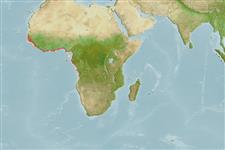
Africa: West-African coast, from Senegal to Angola (Ref. 57403, 79590), including most offshore islands - Macias Nguema, São Tomé, and Principe islands (Ref. 10814). Also reported from Mauritania (Ref. 5377). Western Central Pacific: Guam (Ref. 35720).
Reports from India (Ref. 29108), Thailand (Ref. 37773), Bangladesh (Ref. 39989), Philippines (Ref. 6956) and Australia (Ref. 38544) need confirmation.
Μήκος κατά την πρώτη ωρίμανση / Μέγεθος / Βάρος / Ηλικία
Γεννητική Ωρίμανση: Lm 9.6, range 8 - ? cm
Max length : 14.7 cm SL αρσενικό/απροσδιόριστο; (Ref. 79590)
Ραχιαίες άκανθες (συνολικά) : 11 - 15; Μαλακές ραχιαίες ακτίνες (συνολικά) : 10 - 13; Εδρικές άκανθες: 1; Μαλακές εδρικές ακτίνες: 8 - 10. Diagnosis: large adult size, approaching 150 mm SL; head width 15.4-21.8% SL (Ref. 5218). Upper lip covered by a skin fold; anterior nostrils conical and tubular, reaching to level of lower lip; posterior nostrils small, slit-like (Ref. 57403, 79590). Snout deep (Ref. 3657). Mouth horizontal (Ref. 3657), large, its gape extending to below center of eye (Ref. 57403, 79590). Eyes protruding and close together with lower eyelid fold (Ref. 3657). Predorsal scales extending anteriorly to level of hind margin of eye; upper margin of operculum, preoperculum and sub-/infraorbital regions, as well as pectoral-fin bases, covered with small, cycloid scales; 86-107 scales in longitudinal series (including usually 3 or 4 scales on caudal fin base) (Ref. 5218, 57403, 79590). First dorsal fin high (Ref. 3657), with 10-14 spines (Ref. 57403, 79590) that are flexible (Ref. 3657). Second dorsal fin with 1 spine and 10-13 soft rays (Ref. 57403, 79590), its base longer than the distance from end to caudal fin origin (Ref. 3657), length of 2nd dorsal fin base 20.9-24. 1 %SL (Ref. 5218). Length of anal fin base 14.1-17.7% SL (Ref. 5218). Pectoral fins with a long muscular lobe (Ref. 3657). Pelvic fins joined by a transverse membrane connecting the bases of the 5th pair of segmented rays (Ref. 57403, 79590). Pelvic fin length 14.2-16.0% SL; no frenum uniting pelvic fins (Ref. 5218). Caudal fin asymmetrical, upper ray longest (Ref. 57403, 79590), lower rays shorter and stout (Ref. 3657). TRDB 20-34 (Ref. 5218).
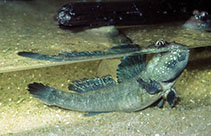
Coloration: in life: fish olive-green or rusty-brown dorsally, paler ventrally; small, blue ocelli scattered over flanks and dorsum, and some oblique, black bands may be present on dorsal part of flanks (Ref. 57403, 79590). 1st dorsal fin is dark on its anterior margin and has a bright blue longitudinal band near its distal margin; 2nd dorsal fin has 2, narrow, bluish-white longitudinal bands on its upper half (Ref. 57403). Anal fin pale or white, and sometimes slightly mottled with fine, dark spots (Ref. 79590). Pectoral fins dark on outer (lateral) surface, with pale distal margins, and lighter on inner (medial) surface, particularly ventrally; pelvic fins whitish on ventral surface but darker on dorsal surface, with pale margins; caudal fin dark (Ref. 57403, 79590). Preserved specimens: dark brown/violet on head, dorsum and flanks; chin pale or mottled gray; ventral body surface pale whitish-yellow (Ref. 57403, 79590). 1st dorsal fin grayish with a black band near distal margin, bordered dorsally and ventrally by a narrow white band; 2nd dorsal fin with a brown margin and a black stripe running along upper portion of fin, this stripe bordered dorsally and ventrally by a narrow white band (Ref. 57403). Anal fin pale or white (Ref. 57403), sometimes slightly mottled with fine, dark spots (Ref. 57403). Caudal fin dark brown on its dorsal part, whitish on its ventral part (Ref. 57403).
Body shape (shape guide): fusiform / normal; Cross section: circular.
Facultative air-breathing (Ref. 126274); Found on muddy substrates and in brackish waters of estuaries, lagoons and mangrove swamps (Ref. 79590). Occasionally found in freshwater, but always close to the shore (Ref. 57403, 79590). Amphibious air-breather (Ref. 31184) that skips or walks on sand or mud in search of food; that is, on exposed intertidal mud flats of estuarine mangrove swamps. Adult feed chiefly on arthropods (crabs, insects, etc.) of the mud surface. Also included in the diet is the white mangrove, Avicennia nitida (Ref. 3026). Spawn in burrows (Ref. 3657). Maximum reported total length 165 mm; reports of larger specimens, up to 250 mm TL, are probably misidentifications of other species (Ref. 79590).
Probably a multiple spawner (Ref. 58481).
Harrison, I.J., P.J. Miller and F. Pezold, 2003. Gobiidae. p. 625-666 In C. Lévêque, D. Paugy and G.G. Teugels (eds.) Faune des poissons d'eaux douce et saumâtres de l'Afrique de l'Ouest, Tome 2. Coll. Faune et Flore tropicales 40. Musée Royal de l'Afrique Centrale, Tervuren, Belgique, Museum National d'Histoire Naturalle, Paris, France and Institut de Recherche pour le Développement, Paris, France. 815 p. (Ref. 57403)
Κατάσταση Κόκκινου Καταλόγου IUCN (Ref. 130435: Version 2025-2 (Global))
Απειλή για τον άνθρωπο
Harmless
Ανθρώπινες χρήσεις
αλιεία: παραδοσιακή αλιεία; Ενυδρείο: Εμπορικό(ά)
Εργαλεία
Ειδικές εκθέσεις
Λήψη XML
Διαδικτυακές πηγές
Εκτιμήσεις βάσει μοντέλων
Προτιμώμενη θερμοκρασία (Αναφ.
123201): 25.1 - 28, mean 27.3 °C (based on 187 cells).
Δείκτης φυλογενετικής ποικιλότητας (Αναφ.
82804): PD
50 = 0.5000 [Uniqueness, from 0.5 = low to 2.0 = high].
Bayesian length-weight: a=0.01072 (0.00706 - 0.01626), b=3.00 (2.88 - 3.12), in cm total length, based on LWR estimates for this species & Genus-body shape (Ref.
93245).
Τροφικό Επίπεδο (Αναφ.
69278): 3.4 ±0.39 se; based on food items.
Ελαστικότητα (Αναφ.
120179): Μεσαίο(α), ελάχιστος χρόνος για διπλασιασμό πληθυσμού 1,4 - 4,4 έτη (K=0.89; Fec=2,100; assuming tm= 2.5 years based on growth curve).
Ευπάθεια στην αλιεία (Ref.
59153): Low vulnerability (25 of 100).
🛈