Classification / Noms
Noms communs | Synonymes | Catalog of Fishes(Genre, Espèce) | ITIS | CoL | WoRMS | Cloffa
>
Perciformes/Serranoidei (Groupers) >
Anthiadidae (Fairy basslets or Streamer basses)
Etymology: Xenanthias: Although Regan (1908) did not specific the allusion of Xenanthias, the name is probably the combination of ξένος (xénos, meaning strange or foreign), and anthias, possibly an indication to a strange anthias.
Eponymy: Pierre Fourmanoir (1924–2007) was a French ichthyologist who mainly worked in New Caledonia for the Paris Museum’s ichthyology laboratory. [...] (Ref. 128868), visit book page.
More on author: Randall.
Taxonomic Remarks
Plectranthias fourmanoiri partially fit into the diagnosis of Xenanthias and inclusion in this genus is tentative.
Environnement : milieu / zone climatique / profondeur / gamme de distribution
Écologie
marin récifal; profondeur 5 - 44 m (Ref. 30874). Tropical; 16°N - 25°S
Indo-Pacific Ocean.
Taille / Poids / Âge
Maturité: Lm ? range ? - ? cm
Max length : 4.7 cm TL mâle / non sexé; (Ref. 90102)
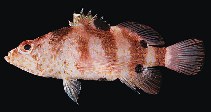
Épines dorsales (Total) : 10; Rayons mous dorsaux (Total) : 16 - 18; Épines anales: 3; Rayons mous anaux: 7. This species is distinguished from its congeners by the following set of characters: no teeth on palatines; dorsal segmented rays usually 16-18 (rarely 20); fourth or fifth dorsal spine longest; pectoral rays 12-13, all unbranched; predorsal scales extend anteriorly only to vertical through mid-pupil; lateral line complete or interrupted, with 15-26 + 0-4 tubed scales. Colouration: a large black spot on the middle portion of dorsal fin, one near the end of the dorsal fin, one over the base of the last four anal rays, and one mid-ventrally on the abdomen in front of the anus (Ref. 123579).
Body shape (shape guide): fusiform / normal.
Inhabits coral reefs in lagoons and exposed areas (Ref. 8944). Deep-dwelling fishes. Feeds on small fishes and crustaceans (Ref. 37816). Solitary in crevices (Ref 90102).
Cycle de vie et comportement reproducteur
Maturité | Reproduction | Frai | Œufs | Fécondité | Larves
Gill, A.C., J.J. Pogonoski, G.I. Moore and J.W. Johnson, 2021. Review of Australian species of Plectranthias Bleeker and Selenanthias Tanaka (Teleostei: Serranidae: Anthiadinae), with descriptions of four new species. Zootaxa 4918(1):1-116. (Ref. 123579)
Statut dans la liste rouge de l'IUCN (Ref. 130435: Version 2025-2 (Global))
Menace pour l'homme
Harmless
Utilisations par l'homme
Pêcheries: d'intérêt potentiel
Outils
Articles particuliers
Télécharger en XML
Sources Internet
Estimations basées sur des modèles
Température préférée (Réf.
123201): 24.7 - 28.8, mean 27.4 °C (based on 138 cells).
Indice de diversité phylogénétique (Réf.
82804): PD
50 = 0.5005 [Uniqueness, from 0.5 = low to 2.0 = high].
Bayesian length-weight: a=0.01413 (0.00621 - 0.03212), b=3.00 (2.81 - 3.19), in cm total length, based on LWR estimates for this (Sub)family-body shape (Ref.
93245).
Niveau trophique (Réf.
69278): 3.8 ±0.61 se; based on food items.
Résilience (Réf.
120179): Haut, temps minimum de doublement de population inférieur à 15 mois (Preliminary K or Fecundity.).
Vulnérabilité de la pêche (Ref.
59153): Low vulnerability (10 of 100).
🛈