>
Carangiformes (Jacks) >
Carangidae (Jacks and pompanos) > Caranginae
Etymology: Trachurus: Greek, trachys, -eia, -ys = rough + Greek, oura = tail (Ref. 45335).
Umwelt: Milieu / Klimazone / Tiefenbereich / Verbreitungsgebiet
Ökologie
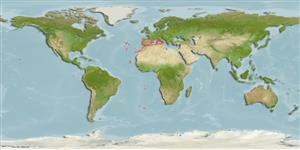
seewasser benthopelagisch; ozeanodrom (Ref. 26139); tiefenbereich 305 - 370 m (Ref. 56504). Subtropical; 45°N - 41°S, 32°W - 17°E
Eastern Atlantic: southern Bay of Biscay to southern Morocco including Azores, Madeira , Canary Islands, Tristan de Cunha and Gough Islands. Also known from the western part of the Mediterranean Sea. Reported from Mauritania (Ref. 55783). Is also reported from the eastern part of Mediterranean by several references that may need confirmation - see the list of countries (NB).
Länge bei der ersten Reifung / Größe / Gewicht / Alter
Geschlechtsreife: Lm 24.7, range 24 - 49.5 cm
Max length : 60.0 cm TL Männchen/unbestimmt; (Ref. 7097); common length : 25.0 cm FL Männchen/unbestimmt; (Ref. 3397); max. veröff. Alter: 18 Jahre (Ref. 109005)
Kurzbeschreibung
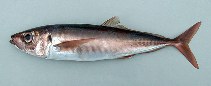
Bestimmungsschlüssel | Morphologie | Morphometrie
Adults are found at depths ranging from 305 to 368 m in the eastern Ionian Sea (Ref. 56504). They can be seen up to depth of 370 m (Ref. 4233). They are confined to neritic zones of island shelves, banks and sea mounts; a schooling species (Ref. 4233). Known to migrate between the coast of Sahara and the offshore seamounts possibly reaching the Cape Verde Islands (Ref. 26139). They feed mainly on crustaceans (Ref. 4233). Eggs are pelagic (Ref. 4233).
Smith-Vaniz, W.F., 1986. Carangidae. p. 815-844. In P.J.P. Whitehead, M.-L. Bauchot, J.-C. Hureau, J. Nielsen and E. Tortonese (eds.) Fishes of the north-eastern Atlantic and the Mediterranean. UNESCO, Paris. vol. 2. (Ref. 4233)
IUCN Rote Liste Status (Ref. 130435: Version 2025-2 (Global))
Bedrohung für Menschen
Harmless
Nutzung durch Menschen
Fischereien: kommerziell
Tools
Zusatzinformationen
Download XML
Internet Quellen
Schätzungen auf der Grundlage von Modellen
Bevorzugte Temperatur (Ref.
123201): 9.6 - 14.1, mean 13.1 °C (based on 5 cells).
Phylogenetischer Diversitätsindex (Ref.
82804): PD
50 = 0.5001 [Uniqueness, from 0.5 = low to 2.0 = high].
Bayesian length-weight: a=0.00912 (0.00799 - 0.01041), b=2.97 (2.94 - 3.00), in cm total length, based on LWR estimates for this species (Ref.
93245).
Trophische Ebene (Ref.
69278): 3.3 ±0.42 se; based on food items.
Generation time: 5.6 (3.5 - 13.7) years. Estimated as median ln(3)/K based on 11
growth studies.
Widerstandsfähigkeit (Ref.
120179): mittel, Verdopplung der Population dauert 1,4 - 4,4 Jahre. (K=0.18; tm=2-5; tmax=18).
Prior r = 0.39, 95% CL = 0.26 - 0.59, Based on 3 full stock assessments.
Anfälligkeit der Fischerei (Ref.
59153): High to very high vulnerability (68 of 100).
🛈
Klimaanfälligkeit (Ref.
125649): Moderate vulnerability (37 of 100).
🛈
Nährstoffe (Ref.
124155): Calcium = 147 [88, 283] mg/100g; Iron = 2.46 [1.41, 4.55] mg/100g; Protein = 18.2 [17.3, 19.2] %; Omega3 = 0.267 [0.158, 0.459] g/100g; Selenium = 37.1 [18.2, 73.5] μg/100g; VitaminA = 22.5 [5.0, 115.0] μg/100g; Zinc = 2.08 [1.45, 3.05] mg/100g (wet weight);