>
Gobiiformes (Gobies) >
Microdesmidae (Wormfishes) > Ptereleotrinae
Etymology: Ptereleotris: Greek, pteron = wing, fin + The name of a Nile fish, eleotris (Ref. 45335).
Eponymy: Helen Randall née Au is a fellow zoologist and wife of the author Dr John ‘Jack’ Ernest Randall Jr. (Also see Randall) (Ref. 128868), visit book page.
More on author: Randall.
Umwelt: Milieu / Klimazone / Tiefenbereich / Verbreitungsgebiet
Ökologie
seewasser riff-verbunden; standorttreu (Ref. 52884); tiefenbereich 3 - 60 m (Ref. 9710). Tropical
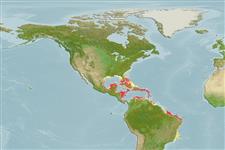
Western Atlantic: southeastern Florida, USA and throughout the Antilles (Ref. 7251), and Brazil (Ref. 40101).
Größe / Gewicht / Alter
Geschlechtsreife: Lm ? range ? - ? cm
Max length : 12.0 cm TL Männchen/unbestimmt; (Ref. 9710)
Kurzbeschreibung
Bestimmungsschlüssel | Morphologie | Morphometrie
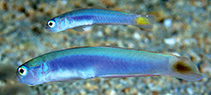
Rückenflossenstacheln (insgesamt) : 6 - 7; Rückenflossenweichstrahlen (insgesamt) : 22 - 24; Afterflossenstacheln: 1; Afterflossenweichstrahlen: 21 - 23. Body pale bluish-gray, with lavender overtones. Fins paler, greenish yellow; caudal fins rounded, moderately long. Mouth very oblique. Scales very small, about 145 in lateral series (Ref. 26938).
Body shape (shape guide): elongated.
Adults are found on sandy or coral rubble bottoms (Ref. 9710). They inhabit 'U-shaped' burrows. Often in pairs. Adults feed on zooplankton and hover head down near burrow (Ref. 9710). Monogamous (Ref. 52884).
Lebenszyklus und Paarungsverhalten
Geschlechtsreife | Fortpflanzung | Ablaichen | Eier | Fruchtbarkeit | Larven
Monogamous mating is observed as both obligate and social (Ref. 52884).
Randall, J.E., 1996. Caribbean reef fishes. Third Edition - revised and enlarged. T.F.H. Publications, Inc. Ltd., Hong Kong. 3nd ed. 368 p. (Ref. 13442)
IUCN Rote Liste Status (Ref. 130435: Version 2025-2 (Global))
Bedrohung für Menschen
Harmless
Nutzung durch Menschen
Tools
Zusatzinformationen
Download XML
Internet Quellen
Schätzungen auf der Grundlage von Modellen
Bevorzugte Temperatur (Ref.
123201): 26.4 - 28.1, mean 27.5 °C (based on 178 cells).
Phylogenetischer Diversitätsindex (Ref.
82804): PD
50 = 0.5000 [Uniqueness, from 0.5 = low to 2.0 = high].
Bayesian length-weight: a=0.00389 (0.00180 - 0.00842), b=3.12 (2.94 - 3.30), in cm total length, based on all LWR estimates for this body shape (Ref.
93245).
Trophische Ebene (Ref.
69278): 3.4 ±0.45 se; based on food items.
Anfälligkeit der Fischerei (Ref.
59153): Low vulnerability (10 of 100).
🛈
Nährstoffe (Ref.
124155): Calcium = 110 [58, 186] mg/100g; Iron = 0.815 [0.490, 1.359] mg/100g; Protein = 18.1 [17.0, 19.1] %; Omega3 = 0.101 [0.057, 0.181] g/100g; Selenium = 31.3 [14.7, 65.4] μg/100g; VitaminA = 207 [72, 626] μg/100g; Zinc = 1.83 [1.22, 2.58] mg/100g (wet weight);